

Why Space Missions Matter: Is Space Exploration Really Necessary for a Country to Become a Superpower?
Space missions are about more than sending astronauts into space. They help countries develop new technology, improve communication, predict weather, protect national security and gain global influence. But does every country need to explore space to become powerful? This article looks at why nations invest in space, whether it is worth the cost, and how countries like Nepal can benefit from satellite technology and scientific research without spending billions on rockets. Ultimately, space exploration matters most when it helps make life better on Earth.

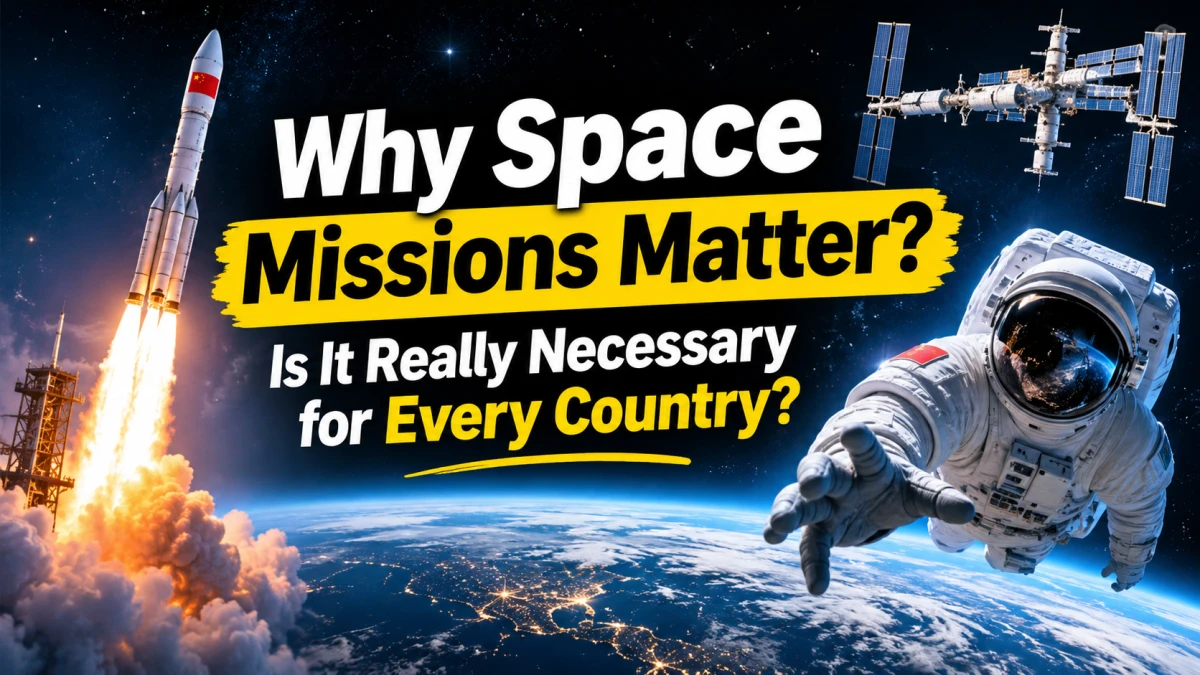
When China sends a Pakistani astronaut to its space station, it is not just a story about a rocket reaching orbit. It is a story about technology, global influence and the future balance of power. But does every country need to spend billions reaching space to become powerful?
China's Shenzhou-24 mission has opened a new chapter in international space cooperation. Pakistani astronaut Muhammad Zeeshan Ali joined Chinese astronauts on a journey to China's Tiangong space station, becoming the first foreign astronaut to visit the station.
The mission is a historic achievement for Pakistan and a demonstration of China's growing ability to offer spaceflight opportunities to international partners.
But beyond the national celebrations and spectacular images of rockets rising into the sky, there is a much bigger question worth asking:
Why are countries investing so heavily in space, and is space exploration really necessary for a country to become a global superpower?
The answer is more complicated than simply reaching the Moon or sending astronauts into orbit.
Space is no longer just about exploration
For decades, space exploration was often presented as a scientific competition between major powers. The United States and the Soviet Union competed to launch satellites, send humans into orbit and eventually land astronauts on the Moon.
Today, space has become deeply connected to everyday life and national power.
Satellites support navigation, telecommunications, weather forecasting, disaster monitoring, agriculture, financial systems and military operations. A country that depends entirely on another nation for these services may face strategic vulnerabilities if access is restricted or disrupted.
Space technology is therefore not simply an achievement to celebrate. It is infrastructure.
A satellite may help farmers understand weather patterns, allow emergency services to monitor floods, support aircraft navigation or provide communication in areas where traditional networks are unavailable.
For countries with strong space capabilities, these technologies can become economic assets and strategic advantages.
Space is a new measure of national power
Traditional superpower status has been associated with military strength, economic influence, industrial capacity and diplomatic reach.
Space is increasingly connected to all of these.
A country capable of designing satellites, launching spacecraft, operating advanced communication systems and conducting scientific missions demonstrates a level of technological development that few nations possess.
Such capabilities can strengthen international partnerships, attract investment and create opportunities for domestic industries.
Space missions also carry symbolic power. When a country sends an astronaut into orbit, it sends a message to the world that it has the scientific institutions, technical expertise and international relationships required to participate in one of humanity's most demanding activities.
However, prestige alone cannot make a country powerful.
A nation might successfully send an astronaut into space while still struggling with unemployment, poor infrastructure or economic instability. A space mission can inspire people, but it cannot automatically solve problems on the ground.
The real measure of space power is what a country can build, learn and sustain beyond a single launch.
Why China and the United States are competing in space
The growing competition between China and the United States is not only about who reaches the Moon first.
Both countries understand that space capabilities can influence their economic and strategic positions for decades.
China has developed its own space station, expanded its satellite capabilities and established ambitious lunar exploration goals. The United States continues to invest in space exploration, commercial spaceflight and satellite infrastructure.
The competition also involves international partnerships.
China's cooperation with Pakistan illustrates how spaceflight can strengthen diplomatic relationships. By providing training and access to its space station, China can expand its influence while helping a partner develop scientific experience.
For Pakistan, the mission offers more than national pride. It provides an opportunity to gain practical knowledge, participate in research and potentially develop future space capabilities.
This is how space becomes a tool of diplomacy: countries do not only compete through technology; they also build relationships through access to it.
Is space exploration really necessary?
This is where the debate becomes important.
Not every country needs to build a massive rocket, establish a space station or send its own astronauts into orbit.
For many nations, these projects would require enormous public investment with uncertain short-term returns.
A country struggling to provide quality education, healthcare, clean water and reliable infrastructure must carefully consider whether expensive human spaceflight is the best use of public money.
There is a difference between needing access to space and needing an independent human spaceflight programme.
Almost every modern country can benefit from satellite services. But only a small number may need to develop the ability to launch astronauts independently.
Countries can purchase satellite data, cooperate with established space agencies, launch small satellites through commercial providers and invest in space-related research without building an entire national programme from scratch.
The important question is not whether every country should go to space.
It is whether every country should have the ability to benefit from space.
What space exploration can bring back to Earth
Space programmes can support scientific research, advanced manufacturing, engineering, robotics and communications technology.
They also create demand for highly skilled professionals, including scientists, software engineers, aerospace specialists and technicians.
Research conducted in space can improve our understanding of human biology, materials, plant growth and other scientific processes.
Satellite technology can help monitor climate change, track natural disasters and support environmental research.
These benefits do not mean every space project will produce a profitable invention or immediate economic return. Some missions are primarily scientific, and their value may become clear only years later.
Still, the broader space economy creates opportunities beyond government agencies. Private companies can develop satellite services, data platforms, communication systems and specialised technologies.
The challenge is to ensure that public investment produces meaningful benefits rather than becoming an expensive symbol of national prestige.
What should Nepal learn from the space race?
For a country like Nepal, the lesson is not that it must immediately launch astronauts or compete with China and the United States.
Nepal's geography makes satellite technology particularly valuable.
The Himalayas are vulnerable to changing weather patterns, landslides, glacial lake outburst floods and other environmental risks. Satellite imagery and remote sensing can help researchers monitor glaciers, identify vulnerable areas and improve disaster preparedness.
Nepal could benefit from stronger investment in satellite data, geospatial technology, remote sensing education and partnerships with international space agencies.
It could also encourage universities and young engineers to participate in small satellite projects, scientific research and space-related technology development.
A country does not need a billion-dollar rocket to begin building space expertise.
It needs skilled people, research institutions, practical goals and access to technology.
For Nepal, the smartest approach may be to use space technology to solve problems on Earth before attempting expensive human spaceflight ambitions.
The hidden danger of turning space into another battlefield
Space exploration also comes with serious risks.
As countries become more dependent on satellites, these systems can become targets during conflicts. Anti-satellite weapons, cyberattacks, interference with navigation signals and the growing amount of orbital debris threaten the long-term sustainability of space.
The more nations treat space as a strategic battlefield, the greater the risk that essential services on Earth could be disrupted.
There is also the question of inequality. If only wealthy countries control the most advanced space infrastructure, poorer nations may become increasingly dependent on foreign technology and data.
Space should therefore be treated as both a strategic domain and a shared environment that requires international cooperation.
Scientific progress loses much of its value if the orbital environment becomes unsafe or inaccessible for future generations.
The real definition of a space power
The Shenzhou-24 mission is a reminder that space is becoming an important part of international politics.
But the real achievement is not simply placing a human being in orbit.
It is developing the ability to use technology to improve life, strengthen institutions, create economic opportunities and contribute to scientific progress.
Some countries may become space powers through independent rockets and human spaceflight. Others may become highly capable through satellites, research partnerships and commercial innovation.
There is no single path.
A country does not have to send an astronaut to the Moon to become successful. Nor does it have to abandon space technology because it has problems on Earth.
The most sensible approach is to invest in space where it creates genuine public value, while refusing to confuse national prestige with national progress.
The future will not belong only to countries that reach space. It will also belong to those that understand how to use space to make life on Earth better.
Frequently Asked Questions
What's Your Reaction?
 Like
0
 Dislike
0
 Love
0
 Funny
0
 Wow
0
 Sad
0
 Angry
0















Comments (0)