

We Sent a Machine 16 Billion Miles Into the Unknown. But Have We Done Enough for the People Back Home?
Voyager 1 has reached one light-day from Earth after nearly five decades in space. Its achievement raises a bigger question about humanity's priorities: why invest in exploring the distant universe when poverty, inequality, hunger, and environmental challenges remain on Earth? This article examines the scientific value of exploration, the search for extraterrestrial life, and the importance of making our own planet a better place.

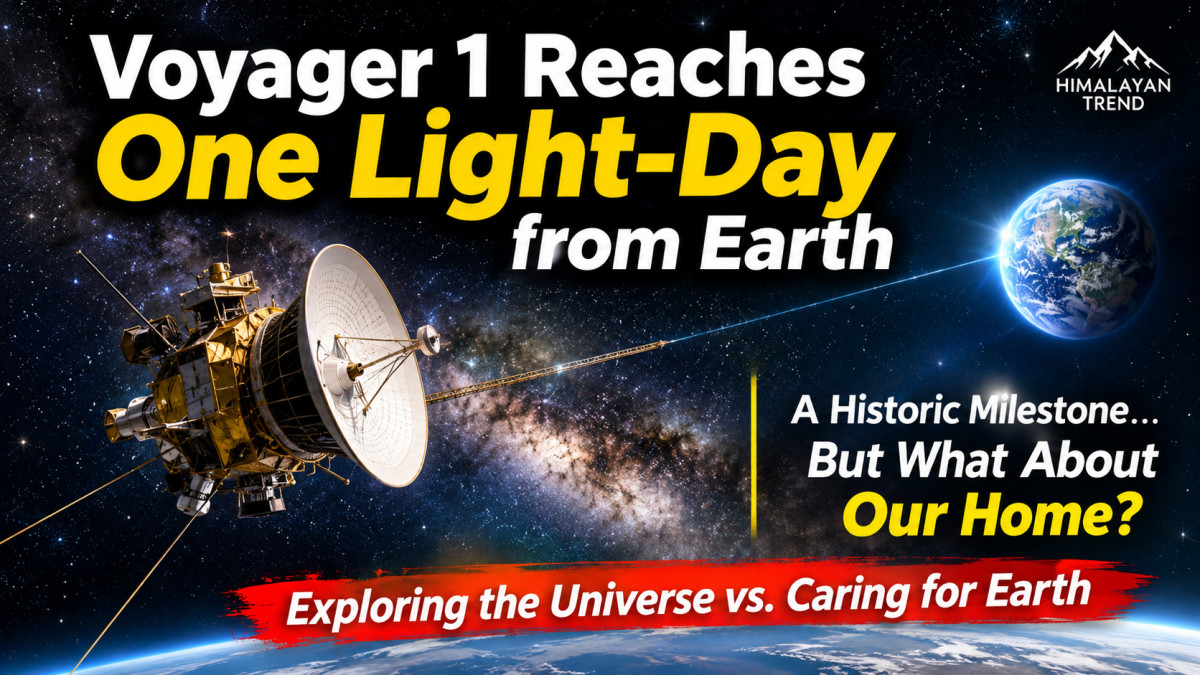
Somewhere beyond the familiar neighbourhood of our Sun, a small spacecraft is travelling through darkness.
It has no passengers. Nobody is looking through its windows. There are no astronauts waiting to land on another planet, no hotels, no restaurants, and no welcoming civilization waiting at the end of its journey.
It is a machine built by human beings almost 50 years ago.
And on November 18, 2026, NASA's Voyager 1 reached a distance of one light-day from Earth.
That means it is approximately 16.1 billion miles, or 25.9 billion kilometres, away. A radio signal travelling at the speed of light takes about 24 hours to reach it. A reply takes another 24 hours to return.
Imagine sending a message today and waiting roughly two days for a response.
That is the distance between humanity and its most distant spacecraft.
The achievement is extraordinary. It is also strangely emotional. A machine built on Earth decades ago is now travelling through a region of space that human beings have never physically visited.
But this remarkable achievement raises another question.
While we are spending money to send machines farther into the universe, millions of people on Earth are still struggling to access clean water, adequate food, healthcare, education, safe housing, and basic opportunities.
Why are we so interested in what exists far beyond our planet when we have not yet solved so many problems here?
Are we searching for another home before learning how to take care of the one we already have?
And if we eventually discover that life exists elsewhere, what will that discovery mean for humanity?
Perhaps Voyager 1's most important achievement is not simply how far it has travelled. Perhaps it is the way it makes us think about the place we left behind.
1. One Light-Day Away: A Machine Has Reached a Distance We Can Hardly Imagine
Let's first understand what actually happened.
NASA launched Voyager 1 on September 5, 1977. Its original mission was to explore Jupiter and Saturn, two enormous planets in our solar system.
It was designed to study planetary atmospheres, magnetic fields, moons, rings, and other features that scientists could not fully understand from Earth.
The mission became much more successful than originally expected.
Voyager 1 passed Jupiter in 1979 and Saturn in 1980. It eventually continued beyond the region dominated by the Sun's solar wind and entered interstellar space in August 2012.
Its twin, Voyager 2, followed a different route, visiting Jupiter, Saturn, Uranus, and Neptune before entering interstellar space in 2018.
Now Voyager 1 has reached another historic milestone.
A light-day is not a measurement of time in this context. It is a measurement of distance: how far light travels in 24 hours.
That distance is approximately 16.1 billion miles.
Voyager 1 travels at roughly 38,000 miles per hour. Even at that speed, it took almost 50 years to reach this milestone.
And here is something even more fascinating.
The spacecraft has not reached another star, another solar system, or a known habitable planet. It is still travelling through interstellar space, studying the environment beyond the Sun's protective influence.
The milestone does not mean that something physically changes when the spacecraft crosses that distance. Its significance is what it represents: humanity has built something capable of travelling farther from Earth than any other human-made object.
NASA's announcement and mission information explain this remarkable achievement in detail.
2. Why Would Humans Spend So Much Money Sending Something So Far Away?
This is a reasonable question.
Space exploration is expensive. Building spacecraft, designing scientific instruments, testing equipment, launching rockets, maintaining communication networks, and employing scientists and engineers all require resources.
So why do governments invest in missions that may take decades to produce scientific results?
The answer is that space exploration is not simply about sending an object somewhere distant.
It is about collecting information that cannot be obtained in the same way from Earth.
Voyager 1 has helped scientists understand the outer planets and the environment between stars. Its measurements have provided information about magnetic fields, energetic particles, cosmic rays, and the boundary between the Sun's influence and interstellar space.
Before spacecraft like Voyager, much of our understanding of these distant regions was based on limited observations.
The spacecraft went there and measured them directly.
There is also a historical lesson in the mission's cost.
NASA's published historical figure for the Voyager program through the Neptune encounter was approximately $865 million, including spacecraft, launch vehicles, nuclear power sources, and tracking support.
That is the historical program figure, not a new expense for the 2026 milestone. It should also not be compared directly with today's dollars without adjusting for inflation.
The mission produced decades of scientific observations from an investment made by an earlier generation.
That is one reason governments sometimes fund research whose full benefits cannot be known when the money is first spent.
The people who approved Voyager did not know exactly how long it would operate or how much scientists would eventually learn from it.
They invested in the possibility of discovery.
3. But What If There Is Nobody Out There?
Here comes one of humanity's biggest unanswered questions.
Are we alone?
The universe contains an extraordinary number of stars, galaxies, and planets. Astronomers have discovered thousands of planets outside our solar system, including some that may have conditions suitable for liquid water.
But there is a major difference between finding a potentially habitable planet and finding life.
So far, scientists have not confirmed any life beyond Earth.
We have not established that another civilization exists. We have not verified that extraterrestrial beings have visited us. We have not received a confirmed message from an intelligent civilization elsewhere.
This uncertainty makes the search both exciting and frustrating.
Imagine spending decades studying distant planets, sending spacecraft into space, building enormous telescopes, and analysing signals, only to discover that we still have no confirmed evidence of life.
Would the effort have been wasted?
Not necessarily.
Science is not valuable only when it produces the answer people hope to receive.
Discovering that a particular environment is unsuitable for life is also knowledge. Learning how planets form, how atmospheres evolve, and how stars influence their surroundings helps us understand the conditions that made Earth possible.
And perhaps the most important possibility is that we might eventually discover that life exists in forms very different from what we imagine.
It could be microbial. It could be simple. It might exist beneath the surface of an icy moon rather than on a planet resembling Earth.
We should remain curious without pretending that we already know the answer.
4. What If Earth Is the Only Place Where Life Exists?
Consider a possibility that is difficult to imagine.
What if Earth is the only planet in the universe where life has developed?
We do not currently know whether this is true. There is no scientific evidence establishing that Earth is unique in this way.
But the possibility raises an extraordinary responsibility.
If Earth is the only known place where life exists, then every forest, ocean, species, ecosystem, and human community becomes part of something incredibly rare.
Our planet is not simply a convenient location where humans happen to live.
It is the only world we have confirmed to support life.
That makes the condition of Earth enormously important.
We are dealing with climate change, biodiversity loss, pollution, resource pressure, conflicts, poverty, and unequal access to opportunities.
Some of these problems are difficult to solve because they involve politics, economics, technology, human behaviour, and international cooperation.
We do not need another planet to understand that our current home deserves protection.
And even if life exists elsewhere, Earth will remain the place where human civilization began.
We should not treat it as disposable.
5. Would It Be Better to Spend Space Money on Making Life Better on Earth?
This is perhaps the most important part of the debate.
Imagine a world where every child has access to quality education.
Imagine communities with safe drinking water, affordable healthcare, reliable electricity, and nutritious food.
Imagine fewer people worrying about whether they can afford basic medical treatment or whether their children will have the opportunities needed to build a secure future.
Wouldn't that be a better use of humanity's resources?
It is difficult to disagree with the importance of these goals.
A civilization capable of sending spacecraft billions of miles away should also be capable of working toward a world where people do not have to live without basic necessities.
But there is a financial and political distinction worth understanding.
Space exploration and social development do not necessarily draw from one single global budget.
NASA is funded through the United States federal budget. Healthcare, education, housing, clean water, and poverty reduction involve different government departments, public institutions, private organizations, and international systems.
A dollar not spent on a particular space mission does not automatically become a dollar that reaches a family in need.
Political decisions, institutions, distribution systems, corruption, infrastructure, and economic inequality all influence whether public money actually improves people's lives.
So the question is not simply whether space exploration should exist.
It is whether governments and societies are investing enough in both scientific progress and human well-being.
There is no reason to believe that a world with better schools and hospitals must abandon astronomy.
Nor should the excitement of exploring space become an excuse for ignoring the suffering of people on Earth.
A responsible civilization should be able to pursue discovery while protecting human dignity.
6. Space Exploration Has Also Helped People on Earth
There is another side to this discussion.
Some technologies developed for space research have found useful applications in everyday life.
NASA's technology transfer and Spinoff programs document innovations connected to space research that have been adapted for commercial and public use.
Examples include developments in medical monitoring, imaging technology, environmental sensors, agriculture, materials, and other engineering applications.
Space research has also helped improve our ability to observe Earth.
Satellites provide information used in weather forecasting, environmental monitoring, communications, navigation, disaster response, and climate research.
These capabilities can directly support people who never follow a space mission or watch a rocket launch.
However, we should be careful not to exaggerate the relationship.
Not every space technology becomes a useful consumer product, and not every benefit can be measured in immediate financial returns.
The important point is that research can produce knowledge and technologies with applications beyond the original mission.
Sometimes an investment made to solve one difficult problem creates an unexpected solution to another.
This is one reason scientific research can have value even when its practical benefits are not immediately visible.
7. What If We Made Life on Earth Better First, Then Explored the Universe Together?
This is an idea worth imagining.
Suppose humanity became better at cooperating.
Suppose countries invested more in education, scientific research, healthcare, infrastructure, and environmental protection.
Suppose children from poor communities had the same opportunity to become scientists, engineers, doctors, and researchers as children from wealthy families.
Imagine how much human talent might become available.
Scientific progress does not depend only on the resources of a few powerful countries.
It depends on people.
There may be brilliant scientists, engineers, mathematicians, and inventors growing up in communities where they cannot access good schools, laboratories, computers, or research opportunities.
A world with greater educational access could bring more people into scientific discovery.
International cooperation can also make complex projects possible.
The International Space Station, for example, represents decades of collaboration between multiple countries and space agencies.
Different nations have contributed research, equipment, technology, astronauts, and operational expertise.
This does not mean the world must become completely equal before it can explore space.
That would be an unrealistic requirement.
But greater cooperation and broader access to education could make humanity's scientific future more inclusive.
Perhaps the next great space engineer is currently a child who simply needs a better opportunity.
8. Can We Really Leave Earth and Build a New Home Somewhere Else?
People often talk about Mars as a possible second home for humanity.
It is an exciting idea.
If Earth faces severe environmental damage, catastrophic events, or other existential threats, could humans eventually survive somewhere else?
The scientific ambition is understandable.
But there is a major difference between visiting another planet and creating a permanent human civilization there.
Mars has an extremely thin atmosphere, very low temperatures, high radiation exposure at the surface, and no breathable air.
Its gravity is also much weaker than Earth's.
Humans would need carefully controlled habitats, reliable power, water systems, food production, radiation protection, medical support, and the ability to repair equipment far from Earth.
Even reaching Mars is a difficult undertaking.
A permanent settlement would introduce much harder challenges.
And what about travelling to another star system?
The nearest star system, Alpha Centauri, is more than four light-years away. At Voyager 1's current speed, reaching a nearby star would take tens of thousands of years.
Voyager 1 is not designed to carry humans, slow down, land, or establish a settlement.
It is a scientific probe travelling on a trajectory that will take it past the vicinity of another star in tens of thousands of years, but it will not arrive there as a functioning spacecraft capable of exploration.
So, yes, humanity is researching technologies that could eventually make deeper space travel possible.
But we are nowhere near having a practical way to move large populations to another star system.
We should be careful about treating another planet as an easy escape from the problems we create on Earth.
9. What Voyager 1 Carries: A Message From a Civilization It May Never Meet
Perhaps the most emotional part of the Voyager mission is not its distance.
It is what the spacecraft carries.
Both Voyager spacecraft carry a Golden Record.
It is a gold-plated copper disk containing sounds, music, greetings in 55 languages, images, and other information selected to represent aspects of life on Earth.
The record was designed as a symbolic message from humanity to whoever might someday discover the spacecraft.
It contains sounds of nature, human activities, music, and greetings from people across different cultures.
Think about what that means.
A group of human beings in the 1970s decided to place a representation of our world aboard a spacecraft that would travel beyond the solar system.
They included sounds from a planet they knew might never be seen by whoever eventually encountered the record.
There is something deeply human about that decision.
We do not know whether another civilization exists.
We do not know whether anyone will ever find Voyager.
We do not even know whether the record will remain readable when that distant possibility arrives.
But humanity sent it anyway.
The Golden Record is not proof that aliens will find us. It is a time capsule, a scientific curiosity, and a symbolic expression of our desire to communicate.
It says something about human beings: even when we do not know who might be listening, we sometimes choose to send a message.
10. What Happens to Voyager 1 Now?
Voyager 1 is almost 50 years old.
It is operating with technology designed and built in a completely different era.
Its power comes from a radioisotope thermoelectric generator, which produces electricity from the heat released by radioactive decay.
That power supply gradually loses capacity.
NASA engineers have therefore been switching off selected systems and instruments to conserve energy and extend the spacecraft's useful life.
There is also a current communications issue.
NASA reported that Voyager 1 stopped returning science and engineering data on November 14, 2026, although its carrier signal was still being received. Engineers were investigating the issue and using trajectory calculations and the signal to confirm its light-day milestone.
This is an important reminder that the spacecraft's journey is not an endless one.
Eventually, its power supply will become insufficient to operate the systems needed for communication.
The probe will continue moving through space, but humanity will no longer be able to communicate with it.
It may become a silent object travelling through the galaxy.
And long after its final transmission, it will still carry the Golden Record.
11. Maybe the Greatest Discovery Is Learning How Precious Earth Really Is
When we look into space, we are searching for answers.
Where did life begin?
Are there other living organisms?
How do planets form?
Could humanity survive beyond Earth?
What is the future of civilization?
These questions are worth asking.
But perhaps every journey away from Earth should also make us think more carefully about the planet we are leaving behind.
We have oceans that support enormous ecosystems, forests that regulate environmental systems, soil that produces food, and an atmosphere that makes human life possible.
We have millions of people with different languages, cultures, experiences, and ideas.
We have problems that are difficult, but not all are beyond our ability to improve.
If we become capable of travelling farther into the universe while becoming less capable of caring for one another, what kind of progress will that represent?
Technological achievement should not be measured only by how far a spacecraft can travel.
It should also be measured by how much better human beings can make life for one another.
A future in which more people have access to education, scientific knowledge, healthcare, and opportunity would be a remarkable achievement in its own right.
And perhaps that future would produce the people, ideas, and cooperation needed to explore even further.
12. We Should Explore the Universe, But We Must Not Forget Our Address
Voyager 1 has travelled farther than any human-made object.
It has taken almost five decades to reach a distance where even a radio conversation with Earth requires approximately two days for a complete round trip.
That is extraordinary.
We should celebrate the scientists, engineers, technicians, and generations of people who made this possible.
We should also keep asking difficult questions about the cost, purpose, priorities, and future of space exploration.
There is nothing wrong with wanting to know what exists beyond our planet.
Curiosity is one of humanity's greatest strengths.
But exploration should exist alongside responsibility.
We should search for life beyond Earth while protecting life on Earth.
We should develop new technologies while making essential services more accessible.
We should dream about visiting other planets while remembering that billions of people still need better opportunities on this one.
Perhaps the ultimate goal is not to choose between Earth and the universe.
It is to become a civilization capable of respecting both.
Voyager 1 is now one light-day away.
Its journey reminds us how far human curiosity can travel.
But before we reach for another world, we should make sure we are doing everything possible to care for the one that made us.
We have sent a message into the darkness of space. Perhaps our next great achievement should be making life on Earth a little brighter for everyone.
Frequently Asked Questions
What's Your Reaction?
 Like
0
 Dislike
0
 Love
0
 Funny
0
 Wow
0
 Sad
0
 Angry
0













Comments (0)