

Why Is It So Hard to Find a Job in America? AI, Hiring Freezes and a Broken Hiring Process
Despite millions of job openings, many Americans are struggling to find work. The problem is not simply AI or a lack of qualifications. A slow-hiring economy, cautious employers, automated screening, ghost job postings and a growing mismatch between applicants and available positions are making the job search increasingly difficult.

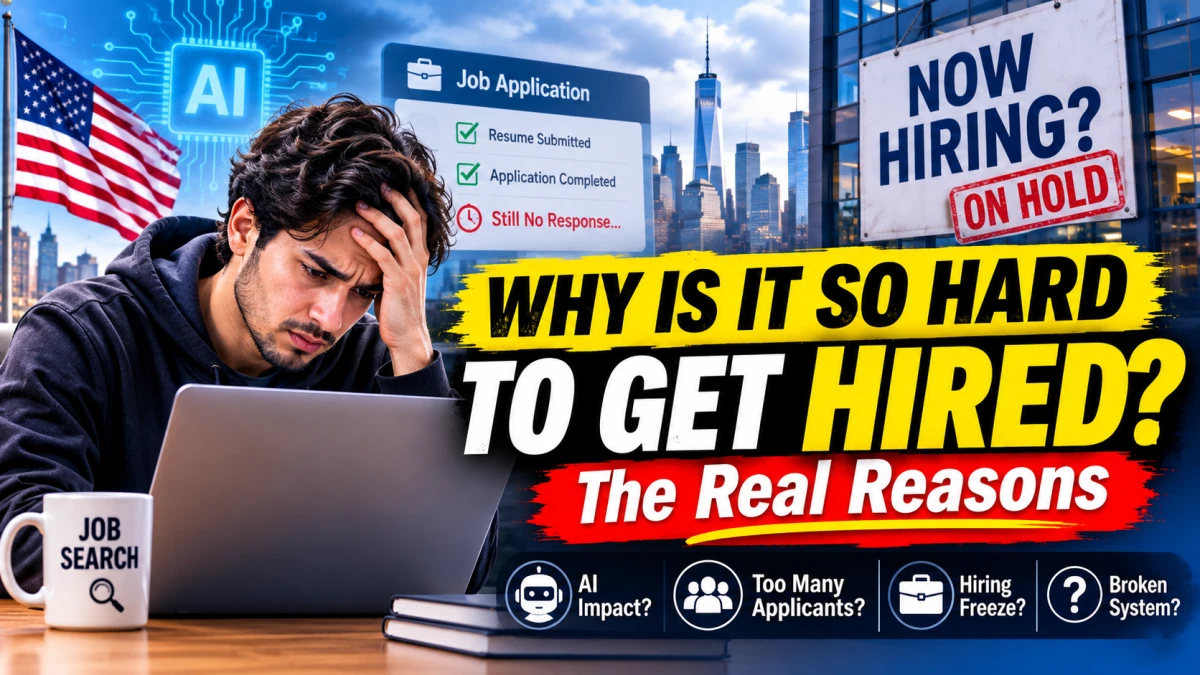
For millions of people across the United States, finding a job has become an exhausting experience.
They update their resumes, apply through company websites, search job boards, contact recruiters, attend interviews and wait for responses that sometimes never arrive. Some have years of experience. Others have degrees, professional certifications and legal authorization to work in the country.
Yet the result is often the same: rejection, silence or another request to apply for a position that may never lead to an actual hire.
This raises a question that deserves more attention than another headline about unemployment: If America still has millions of job openings, why are so many qualified people struggling to get hired?
The answer is more complicated than artificial intelligence taking everyone's jobs.
America's employment problem is increasingly about the distance between a company saying it needs workers and that company actually deciding to hire someone.
The American job market is not simply running out of jobs
The latest available government data paints a complicated picture.
The U.S. Bureau of Labor Statistics reported approximately 7.5 million job openings in September 2026. Employers hired about 5.4 million workers during that month. The October employment report showed that the economy added 165,000 jobs, while unemployment stood at 4.1%.
These numbers do not describe an economy where hiring has completely stopped.
But they also do not mean every job seeker has a realistic chance of finding suitable employment quickly.
A job opening is a snapshot of a position reported as vacant at a particular time. A monthly hiring figure counts people who entered payrolls during the month. They are different measurements, and neither tells an individual applicant how many suitable jobs exist in their city, profession or experience level.
A person searching for an entry-level marketing position in California is not competing for every healthcare, construction, government or engineering vacancy in the country.
The national job market can look reasonably healthy while particular workers experience a very difficult search.
That is the first misunderstanding: millions of vacancies do not automatically translate into millions of accessible opportunities.
The real problem may be a low-hire economy
One of the most frustrating features of the current labor market is that companies can be reluctant to hire even when they are reluctant to lay people off.
Economists often describe this as a low-hire, low-fire environment.
Employers may be keeping their existing employees while delaying the addition of new ones. They may have enough staff to continue operating, but not enough confidence to expand.
This creates a difficult situation for job seekers.
When someone leaves a company, the employer may distribute that person's responsibilities among existing employees instead of immediately replacing them. A department may continue functioning with fewer workers. A business may postpone a new project until it has more certainty about revenue.
The company does not necessarily announce a hiring freeze. It simply stops making hiring decisions quickly.
For someone searching for work, the difference is almost invisible. They see a job posting, submit an application and wait.
The employer may be considering candidates, waiting for budget approval or quietly reconsidering whether the position is necessary.
The result is a job market where opportunities exist, but the path from application to employment is much narrower than it appears.
Is artificial intelligence taking away jobs?
Artificial intelligence is part of the story, but it is not the entire explanation.
AI can perform or assist with tasks that previously required human workers. Writing, basic research, customer support, data processing, document preparation and certain programming tasks are increasingly being automated or accelerated.
When a company can complete more work with fewer employees, it may decide not to replace every departing worker.
Some roles may disappear. Others may change. Certain entry-level positions may become harder to find because employers can use AI to handle tasks that previously helped new employees gain experience.
Research from the Federal Reserve Bank of Dallas found that job postings for occupations with greater exposure to generative AI declined relative to less-exposed occupations, with effects particularly relevant to early-career workers.
However, research from the Federal Reserve Bank of New York found that AI was not the main explanation for the overall slowdown in job postings.
The important distinction is this: AI may be reducing demand for certain tasks and changing which workers companies need, but it cannot explain every hiring delay, every rejection or every difficult job search.
Blaming AI for everything may actually hide the other problems that employers and job seekers need to address.
Companies are becoming more selective than ever
A company receiving hundreds of applications for one position has a different problem from a company receiving only a handful.
Today, online applications make it possible for job seekers to apply to many positions quickly. AI tools can help applicants tailor resumes, write cover letters and submit applications at scale.
Employers are responding with automated screening systems, keyword filters and increasingly complex selection processes.
This creates a strange situation.
Applicants use technology to apply faster. Employers use technology to reject or rank applicants faster. Both sides may be using automation, but neither necessarily gets a better result.
A qualified candidate can be overlooked because their resume does not use the exact terminology in a job description. Another candidate may have a polished resume but lack the practical skills the employer actually needs.
The hiring process becomes less about identifying the best person and more about surviving a series of filters.
In an August 2026 report, Axios described how application volumes, AI screening and longer hiring timelines were contributing to frustration among job seekers. The report also cited research suggesting that a meaningful share of job listings may not represent positions employers are actively trying to fill.
The problem is not simply that companies have too many applicants.
It is that the process for identifying the right applicant may be becoming less effective.
The rise of ghost jobs and inactive listings
Another reason job seekers feel discouraged is the possibility that some advertised positions are not actively being filled.
These are often called ghost jobs.
A ghost job may remain online after a company has paused hiring, filled the position internally or changed its staffing plans. Some employers also maintain ongoing listings to build an applicant pool for future vacancies.
Not every old listing is deliberately misleading. Hiring needs can change, and job boards may not update immediately.
But the effect on applicants can be similar.
Someone spends time preparing an application, researching a company and possibly completing several screening questions for a role that may not lead to an interview.
After repeating this process dozens of times, job seekers begin to question whether the positions they see are real opportunities.
That uncertainty damages trust.
A job board should help people find work. When applicants cannot tell whether a listing represents an active hiring decision, the job search becomes a guessing game.
Employers may not trust applicants, and applicants may not trust employers
The hiring process is experiencing a two-sided trust problem.
Employers worry about fake resumes, exaggerated experience, automated applications and candidates who disappear during the hiring process.
Job seekers worry about fake listings, automated rejection, unclear requirements and interviews that lead nowhere.
AI has made it easier to produce professional-looking application materials. That can help qualified candidates communicate their experience, but it can also make it harder for employers to distinguish genuine expertise from polished presentation.
As a result, some employers add more screening stages, assessments and interviews.
The intention may be to reduce hiring mistakes.
But excessive screening can create another problem: good candidates may lose interest or accept another offer before the company makes a decision.
A process designed to protect employers from making the wrong choice can make it harder for them to make any choice at all.
Why even green card holders can struggle to find work
A permanent resident of the United States has authorization to work without needing employer sponsorship.
That is an important advantage compared with someone whose employment depends on a specific visa or sponsorship arrangement.
But legal work authorization is only one part of the hiring decision.
Employers also consider experience, skills, location, salary expectations, communication, availability and whether a candidate matches the responsibilities of the position.
A green card does not guarantee an interview or employment. It removes a major legal barrier, but it does not remove competition or weak hiring demand.
Some applicants may also encounter employers or recruiters who misunderstand immigration categories and incorrectly assume that a permanent resident requires sponsorship.
That is a separate problem from the general labor market. Employers should understand that lawful permanent residents are authorized to work in the United States and should not be treated as requiring visa sponsorship simply because they were born outside the country.
The broader lesson is that a person's ability to work legally and an employer's willingness to hire are two different things.
Experience requirements are creating a difficult cycle
One of the most frustrating issues for younger workers and career changers is the demand for experience.
Employers often want candidates who can begin contributing immediately. They may prefer someone who has already performed the same role at another company.
But where are new workers supposed to gain that experience?
If entry-level jobs require previous experience, and employers reduce entry-level hiring because of automation or cost concerns, the pathway into professional employment becomes increasingly narrow.
This creates a cycle:
-
Employers want experienced workers.
-
New workers struggle to obtain their first opportunity.
-
Experienced workers compete for positions that once went to beginners.
-
Employers become even more selective.
The result is a labor market where qualifications may be increasing faster than the number of opportunities available to people who are just starting out.
The hidden cost of hiring slowly
Companies often focus on the cost of hiring the wrong person.
That is understandable. A poor hiring decision can be expensive, especially in specialized roles.
But there is also a cost to not hiring.
When a company leaves a position vacant for months, existing employees may become overworked. Projects may be delayed. Customer service may deteriorate. Managers may spend more time covering staffing gaps instead of developing their teams.
A company can save money by postponing a hire, but it may also lose productivity and opportunities.
The same applies to the hiring process itself.
A company that takes too long to make decisions may lose qualified candidates to competitors. A business that relies entirely on automated screening may overlook people who could perform the job exceptionally well.
The question employers should ask is not only whether they can afford to hire someone.
It is whether they can afford to continue operating without the right person.
What needs to change?
The job market does not need another promise that every worker should simply improve their resume.
Job seekers can improve their applications, develop skills and build professional networks. Those actions matter.
But employers and the hiring industry also have responsibilities.
Companies should remove inactive listings, communicate clearly about hiring timelines and avoid unnecessary screening stages.
Recruiters should evaluate candidates based on relevant skills rather than relying exclusively on automated resume scores.
Employers should reconsider entry-level requirements and provide realistic pathways for people to gain experience.
AI should help identify qualified candidates, not become an invisible barrier that prevents them from being considered.
And job boards should make it easier for applicants to distinguish active opportunities from listings that are no longer being filled.
A better hiring system would not guarantee every applicant a job.
It would make the process more transparent, more efficient and more capable of recognizing genuine talent.
The real reason finding a job feels so difficult
America's job market is not simply a story of AI replacing workers.
It is a combination of slower hiring, cautious employers, changing skill requirements, automated screening, inactive job listings and a growing mismatch between what companies need and what applicants can demonstrate.
The economy can continue creating jobs while individual workers struggle to find them.
A company can report millions of vacancies while a qualified applicant receives no response.
And a person can have the legal right to work, the education to perform a job and the motivation to succeed, yet still remain unemployed because the hiring process never connects them with the right opportunity.
The deeper problem is not only a shortage of jobs.
It is a shortage of successful matches between employers and people who are ready to work.
The American job market may not be broken because nobody wants to hire. It may be failing because too many hiring decisions are delayed, filtered, misdirected or never completed.
Until employers, recruiters and technology platforms address that gap, finding a job may remain far harder than the number of advertised openings suggests.
Frequently Asked Questions
What's Your Reaction?
 Like
0
 Dislike
0
 Love
0
 Funny
0
 Wow
0
 Sad
0
 Angry
0













Comments (0)