

Are We Living in Reality or Escaping Into Virtual Worlds? The GTA 6 Phenomenon and the Lost Art of Living
The extraordinary excitement surrounding GTA 6 raises a bigger question about modern life: why are so many people drawn to virtual worlds? This article explores the psychology of gaming, the appeal of digital freedom, the influence of social media, the difference between healthy entertainment and escapism, and why real-life experiences deserve more of our attention.

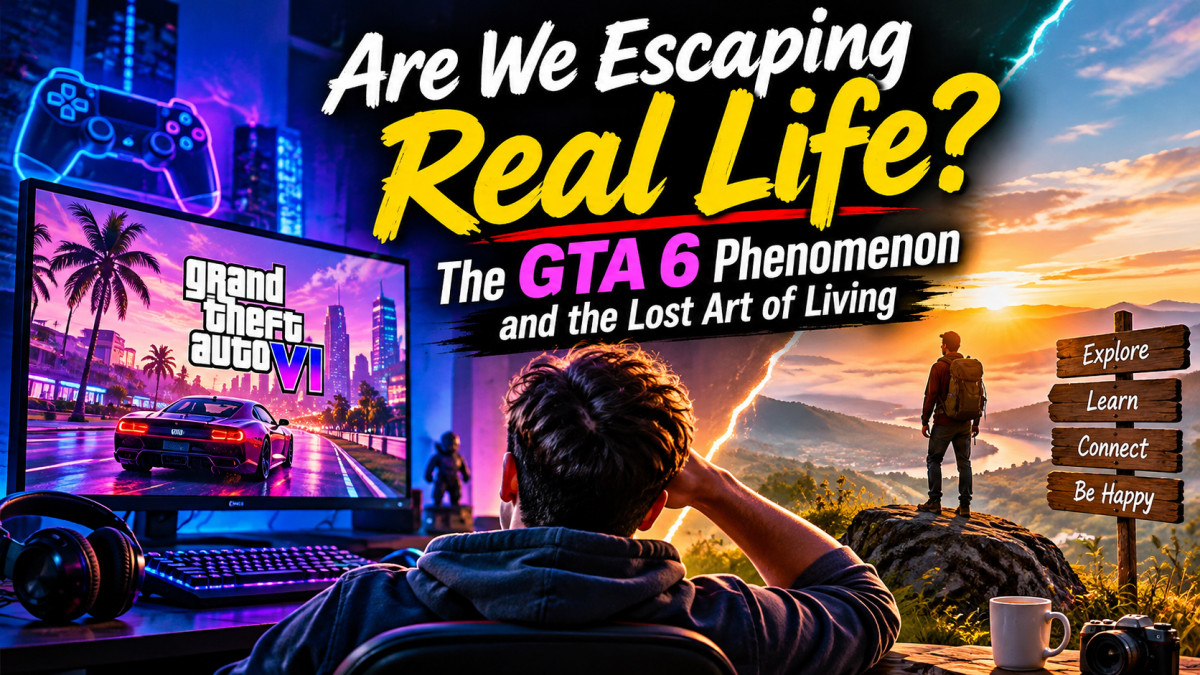
There is something fascinating about the excitement surrounding Grand Theft Auto VI. For years, people have discussed its trailers, characters, graphics, locations, music, and possible gameplay. As its November 19, 2026 release approaches, the conversation has grown beyond the gaming community. People are discussing taking time off work, planning their schedules, preparing their gaming setups, and counting down the hours until they can enter a fictional world.
But behind all this excitement is a question worth asking:
Why are we sometimes more excited about entering a virtual world than experiencing the real one?
Think about it for a moment. The world outside our windows is full of places we have never visited, people we have never met, skills we have never learned, conversations we have never had, and experiences we may never get back. Yet millions of people are preparing to spend hours exploring a digital city that exists only on a screen.
Is this simply entertainment? Is it a new form of social culture? Or does it reveal something deeper about how modern people are choosing to spend their lives?
This is not an argument against video games. Gaming can be an extraordinary form of art, storytelling, creativity, and social connection. The question is not whether people should play games. It is whether we sometimes become so absorbed in virtual experiences that we forget to build meaningful experiences in our actual lives.
1. Why Is Everyone So Excited About GTA 6?
Grand Theft Auto is not just another video game franchise. It has become a recognizable part of global entertainment culture.
The previous major installment, GTA V, arrived in 2013. More than a decade of anticipation has helped turn its successor into an enormous entertainment event.
There are several reasons for this excitement.
First, nostalgia. Many people who played earlier GTA titles have grown up with the franchise. They remember playing GTA Vice City or San Andreas after school, exploring cities, completing missions, and discovering things without following a guide. GTA 6 represents a return to a familiar entertainment universe.
Second, technological expectations. Modern gaming hardware makes it possible to create increasingly detailed environments, realistic lighting, complex characters, and interactive experiences. Players want to see how far the medium has progressed.
Third, curiosity. People want to discover what Rockstar has created. They want to explore the fictional world, experience the story, and see what others have been discussing for years.
Fourth, social participation. When a major game becomes a cultural event, playing it can feel like joining a worldwide conversation. People do not want to miss the jokes, discoveries, livestreams, and discussions.
A November 2026 Ipsos survey in Great Britain found that 71% of adults aged 18–45 who were familiar with GTA 6 planned to purchase it. The survey also found that some younger respondents were concerned about missing conversations with friends if they did not play.
That last finding is particularly interesting. For some people, the excitement is not only about the game. It is also about being part of the conversation surrounding it.
GTA 6 is therefore more than a software release. It is a cultural moment.
But cultural excitement also gives us an opportunity to examine our relationship with entertainment.
2. Virtual Worlds Offer Something Real Life Cannot Always Provide
Imagine two different experiences.
In the first, you wake up, go to work, deal with responsibilities, pay bills, face uncertainty, and repeat much of the same routine tomorrow.
In the second, you enter a digital city where you can explore unfamiliar streets, drive different vehicles, follow a story, complete challenges, and experience situations that would be impossible or dangerous in everyday life.
Which environment sounds more immediately exciting?
For many people, the answer is obvious.
Real life is unpredictable. Progress can be slow. Success takes time. Relationships are complicated. Financial responsibilities do not disappear simply because we are tired.
Virtual environments, on the other hand, offer structured experiences. They provide objectives, feedback, entertainment, and opportunities to experiment.
A game can give someone a sense of achievement in an evening. Real-world goals may take months or years.
That difference matters.
People are not necessarily choosing virtual worlds because they dislike reality. Sometimes they choose them because virtual experiences are easier to access, more immediately rewarding, and less demanding.
The danger begins when temporary enjoyment becomes a permanent substitute for facing the parts of life that need attention.
3. The Psychology of Escapism: Why We Want to Leave Reality Behind
Escapism is the desire to temporarily move away from unpleasant thoughts, emotions, responsibilities, or circumstances through another experience.
It can take many forms:
-
Watching movies for hours.
-
Scrolling through social media.
-
Reading fictional stories.
-
Spending time in video games.
-
Imagining a different life.
-
Constantly consuming entertainment to avoid uncomfortable feelings.
Escapism is not automatically unhealthy. Taking a break from stress can be perfectly reasonable. A good game or film can help someone relax after a difficult day.
However, there is an important difference between taking a break from reality and consistently avoiding it.
Research published in 2023 reviewed studies on escapism through virtual gaming. It found that gaming-related escapism has different possible outcomes. Some findings connected maladaptive escapism with psychological difficulties and less adaptive social behavior, while other findings identified potential benefits such as belonging, confidence, and social connection.
The important lesson is that motivation matters.
Someone who plays a game because they enjoy its design, story, or challenge may have a very different experience from someone who feels unable to cope with everyday life without escaping into it.
The same activity can serve different emotional purposes for different people.
4. Why Does a Virtual Achievement Sometimes Feel More Rewarding Than a Real One?
Consider the difference between completing a difficult game mission and pursuing a real-life goal.
In a game, the objective is usually clear. You know what you need to do. You can see your progress. You receive feedback when you succeed.
In real life, things are rarely so straightforward.
You might work hard for months without getting a promotion. You might study for years before finding the right opportunity. You might start a business and experience several failures before making a profit.
Real progress often comes with uncertainty.
Games are designed experiences. They create challenges, goals, feedback, and a sense of progression. These features can make them engaging.
In everyday life, however, progress is less predictable.
There is no achievement notification when you finally become financially responsible. No trophy appears when you improve your relationship with your family. Nobody announces that you have become more disciplined.
Yet these quiet achievements can have far greater consequences for your future.
This creates an interesting contrast: virtual achievements are often easier to recognize, while real achievements can take much longer to appreciate.
Perhaps one of the most important things we can learn from games is not to abandon reality, but to bring a sense of purpose, curiosity, and progress into it.
5. Social Media Has Turned Gaming Into a Worldwide Spectacle
In the past, someone could play a video game privately and enjoy the experience without telling anyone.
Today, gaming exists inside a much larger entertainment ecosystem.
A single release can generate:
-
Millions of trailer views.
-
Livestreams and reaction videos.
-
Online countdowns.
-
Gameplay predictions.
-
Memes and discussions.
-
Influencer promotions.
-
Gaming merchandise.
-
Community competitions.
People can spend weeks watching content about a game before they even play it.
This changes the nature of anticipation.
Sometimes the excitement surrounding an experience becomes almost as important as the experience itself.
Social platforms reward attention. Dramatic reactions, predictions, arguments, and controversial opinions can attract engagement. As a result, a game can remain part of someone's daily online routine long before its release.
There is nothing inherently wrong with following entertainment news. The question is whether we are choosing what deserves our attention or allowing online trends to make that decision for us.
When every major release becomes an event that everyone is expected to discuss, entertainment can begin to feel like an obligation rather than a personal choice.
6. Are We Becoming Spectators of Life Instead of Participants?
This is perhaps the bigger issue.
We watch people travel instead of planning our own journeys. We watch people build businesses instead of developing our own ideas. We follow other people's achievements, relationships, lifestyles, and adventures.
We watch someone else explore a virtual city while our own surroundings remain unexplored.
Entertainment is not the enemy. Watching a travel documentary can inspire someone to travel. Following an entrepreneur can encourage someone to start a business. Watching a great film can introduce people to new perspectives.
But there is a difference between being inspired by an experience and endlessly consuming representations of it.
A person can spend hours watching videos about fitness without exercising. They can follow travel creators for years without visiting somewhere new. They can watch productivity videos while continually postponing meaningful work.
Gaming can become part of the same pattern when playing or watching others play takes the place of activities that matter to someone.
The problem is not the screen itself. It is the possibility of spending more time observing life than participating in it.
7. Is Gaming Actually Bad for Us? The Answer Is More Complicated
It would be unfair and inaccurate to say that everyone who plays video games is wasting their time.
Gaming has several legitimate benefits.
Creativity and imagination: Games can introduce players to imaginative environments, visual storytelling, music, and complex fictional worlds.
Social connection: Multiplayer games can help friends stay connected, particularly when they live in different places.
Challenge and learning: Some games involve planning, problem-solving, coordination, and strategic decision-making.
Relaxation: Enjoyable gaming can provide a recreational break from work and other responsibilities.
Career opportunities: Game development, animation, sound design, competitive gaming, streaming, and related industries provide professional opportunities for some people.
However, enjoying games and experiencing gaming-related harm are not the same thing.
The World Health Organization recognizes gaming disorder in the International Classification of Diseases. Its definition focuses on impaired control over gaming, increasing priority given to gaming over other activities, and continuing or escalating the behavior despite negative consequences.
Importantly, the WHO explains that the behavior must be severe enough to cause significant impairment in important areas of life, normally evident for at least 12 months, for a diagnosis.
Playing frequently does not automatically mean someone has a disorder.
The real concern is whether gaming begins to interfere with sleep, education, employment, relationships, financial responsibilities, or personal well-being.
A hobby should add something to life, not quietly take everything else away.
8. The Bigger Question: Why Does Real Life Sometimes Feel Less Interesting?
Perhaps the most uncomfortable question is not why people love video games.
It is why some people find ordinary life so difficult to enjoy.
Modern life can be demanding. Many people face financial pressure, uncertain careers, loneliness, relationship difficulties, rising living costs, and constant comparisons with others.
A person may spend years working toward a better future without knowing whether their efforts will succeed.
Meanwhile, digital entertainment offers an immediate alternative.
It is available at almost any hour. It does not require travel. It does not demand the same emotional vulnerability as real relationships. It allows people to enter another environment whenever they want.
But there is another factor: expectations.
Social media can make ordinary life look disappointing by constantly displaying extraordinary moments. We see luxury holidays, expensive cars, beautiful homes, successful businesses, and seemingly perfect relationships.
Our everyday experiences begin to look small in comparison.
Then we enter a virtual world where almost anything seems possible.
The contrast can make reality feel even less exciting.
But ordinary life was never supposed to resemble a movie or a video game. Some of its most meaningful moments are quiet: a conversation with someone you love, a meal shared with family, a new skill learned through patience, a walk in an unfamiliar place, or a goal achieved after years of effort.
These moments may not generate millions of views, but they are still part of a meaningful life.
9. What If We Put the Same Excitement Into Our Real Lives?
Imagine if people approached their personal goals with even a fraction of the enthusiasm they bring to a major game release.
What if we were just as excited about learning a new skill as we are about exploring a new digital map?
What if we planned real journeys with the same anticipation we give virtual adventures?
What if we treated personal growth as a long-term mission?
There are practical ways to make this happen.
Create real-world goals. Choose something meaningful that you want to accomplish, whether it is learning a language, improving your health, starting a business, or exploring a new place.
Make progress visible. Keep a record of your achievements. A journal, calendar, or simple checklist can help you recognize progress that might otherwise go unnoticed.
Build experiences instead of only consuming them. Cook something new, meet a friend, explore your neighborhood, learn an instrument, or create something with your hands.
Protect your attention. Decide when you want to play games or use social media rather than allowing notifications and online trends to control your schedule.
Stay connected to people outside screens. Digital friendships can be meaningful, but in-person relationships and shared experiences also deserve attention.
Enjoy entertainment without guilt. You do not need to turn every moment into a productivity exercise. Rest, play, and enjoyment are important parts of life too.
The objective is not to eliminate digital entertainment. It is to make sure that entertainment remains one part of a much larger life.
10. Maybe the Real Problem Is Not Virtual Reality, but an Unlived Reality
There is nothing wrong with wanting to explore Vice City.
There is nothing wrong with being excited about a beautifully designed game, following its development, or spending a weekend enjoying it.
But imagine reaching the end of another year and realizing that most of your excitement came from watching other people's lives, following digital trends, and exploring fictional environments.
What happened to the places you wanted to visit?
What happened to the ideas you wanted to develop?
What happened to the people you wanted to spend more time with?
What happened to the version of yourself you hoped to become?
These are questions worth asking—not because gaming is bad, but because time is limited.
A fictional world can offer an incredible experience, but it cannot live your life for you.
A game can give you missions, characters, stories, and achievements. It cannot make your personal decisions, build your relationships, or create your memories outside the screen.
The real world is not always exciting. Sometimes it is repetitive, unfair, exhausting, and unpredictable.
But it is also where genuine relationships are formed, meaningful work is created, difficult challenges are overcome, and memories become part of who we are.
Perhaps the answer is not to stop playing games.
Perhaps it is to make sure we are not forgetting to play our part in the only life we actually get to live.
Final Thoughts: Don't Let the Virtual World Become Your Entire World
GTA 6 may become one of the biggest entertainment events of its generation. Millions of people will enjoy it, discuss it, and create memories around it. That excitement is part of modern popular culture.
But perhaps this moment also gives us a reason to reflect on our relationship with technology.
Enjoy the game. Appreciate the creativity behind it. Explore its fictional world.
Then remember that there is an actual world outside your screen, filled with experiences that cannot be downloaded, relationships that cannot be replaced by avatars, and opportunities that will not wait forever.
Don't spend your entire life watching, playing, and imagining other worlds while forgetting to create something meaningful in your own.
Because the greatest experience is not necessarily the most realistic virtual world. It may be the real life you finally decide to participate in.
Frequently Asked Questions
What's Your Reaction?
 Like
0
 Dislike
0
 Love
0
 Funny
0
 Wow
0
 Sad
0
 Angry
0













Comments (0)