

Singapore's AI Boom Is Making the Economy Richer. But Will Workers Feel the Growth?
Singapore's economy is expected to grow around 6% in 2026, driven partly by AI-related demand. But as businesses become more productive, workers face a difficult question: will the AI boom create better opportunities or make jobs less secure?

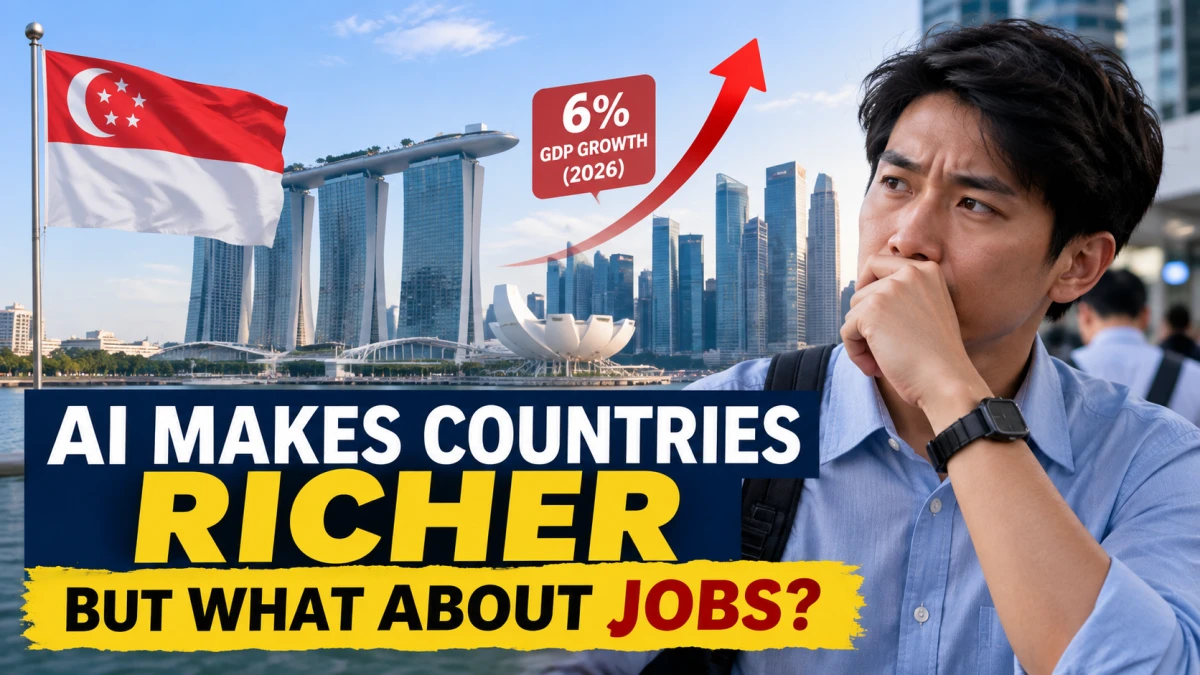
Singapore's growth forecast has climbed to around 6% as artificial intelligence drives demand for technology and exports. Yet the economic success of AI raises a difficult question: can a country become richer while ordinary workers feel less secure about their future?
There is something unusual about the current AI economy.
A company can report stronger productivity without hiring more people. A factory can produce more with fewer manual steps. A business can expand its operations while using software to handle work that once required an entire team.
And a country can celebrate faster economic growth while some of its workers quietly wonder whether their jobs will look the same in a few years.
Singapore is now an interesting example of this contradiction.
On November 24, 2026, Singapore raised its full-year economic growth forecast to around 6%, following stronger-than-expected performance in the third quarter. The economy grew 6.1% year over year between July and September, supported in part by strong demand connected to artificial intelligence. Reuters reported that the government also expects growth to moderate to between 2.5% and 4.5% in 2027.
The numbers are impressive.
But the bigger story may not be how quickly Singapore is growing. It may be what this growth tells us about the future of work.
The AI boom is creating economic winners
Artificial intelligence is no longer just a technology experiment happening inside research laboratories.
It has become a major source of demand for semiconductor equipment, electronics, specialised machinery, data centres, cloud computing, and digital infrastructure.
Singapore is well positioned to benefit from this expansion.
The country has a strong manufacturing base, an established financial sector, advanced logistics infrastructure, and a role in global technology supply chains.
When companies around the world invest heavily in AI, Singapore can benefit through increased production, exports, investment, and trade.
The latest growth figures reflect that momentum.
According to Singapore's Ministry of Trade and Industry, strong AI-related demand supported manufacturing, electronics, precision engineering, and wholesale trade. The country's growth forecast was raised from the previous range of 4.5% to 5.5% to around 6%.
That is a significant upgrade.
Yet economic growth does not automatically tell us how every household is doing.
GDP measures the value of economic activity. It does not directly tell us whether a particular worker has received a raise, whether a recent graduate has found a suitable job, or whether an employee feels confident about remaining in the same profession.
This is where the AI story becomes more complicated.
The economy may need fewer people to produce more
For decades, economic growth was closely associated with expanding businesses, increasing production, and hiring more workers.
Artificial intelligence is changing that relationship.
A company that once needed a large team to process documents, analyse data, prepare reports, or respond to routine customer questions may now be able to complete some of those tasks with AI assistance.
That does not necessarily mean the company will dismiss everyone involved.
It may instead decide to expand without increasing its workforce. It may reduce recruitment, redesign existing positions, or move employees into different responsibilities.
From the company's perspective, this can be a productivity success.
From the worker's perspective, it can feel like a much less certain future.
The difference between those two experiences is becoming one of the central questions of the AI economy.
A business may be celebrating that it can do more with fewer resources. An employee may be wondering whether the next efficiency improvement will make their position less necessary.
Both reactions can be true at the same time.
Singapore's own data offers a more complicated picture
It would be inaccurate to say that Singapore's AI boom has already resulted in widespread job losses.
In April 2026, Singapore's Ministry of Manpower published its first major report on AI adoption among firms.
The findings showed that AI was delivering productivity gains, but adoption was still uneven. A majority of surveyed firms had not yet adopted the technology.
Among firms using AI, 70.7% reported improvements in worker productivity.
At the same time, only 6.2% reported reduced headcount after adopting AI. More commonly, businesses reported redesigning job roles or creating new AI-related positions. The Ministry of Manpower's report suggested that AI was primarily changing how work was performed rather than causing widespread workforce displacement.
That distinction matters.
The early stages of technological change do not always produce immediate mass unemployment. Sometimes the first visible effect is that businesses stop hiring as many people for certain tasks.
The pressure may appear gradually through fewer entry-level openings, changing job descriptions, or higher expectations for employees to use technology.
A worker may still have a job, but the job they were trained for could be disappearing piece by piece.
The uncomfortable question for young workers
One group deserves particular attention: people entering the workforce.
Many entry-level positions involve tasks that are repetitive, structured, and relatively easy to learn.
Those tasks have traditionally allowed new employees to gain experience before moving into more complex responsibilities.
AI can now perform parts of that work.
A junior employee might previously have spent hours preparing a first draft, organising information, checking records, or creating basic reports. AI tools can reduce the time required for some of these activities.
That creates an important challenge for employers.
If AI performs much of the basic work, how will young workers gain the experience needed to become senior professionals?
A company cannot simply eliminate every entry-level responsibility and expect a future generation of experienced employees to appear automatically.
The early stages of a career are not only about producing work. They are also about learning how to think, make decisions, understand customers, and take responsibility.
If AI changes the traditional training process, businesses will need to develop new ways to teach those skills.
Otherwise, the productivity gains of today could create a shortage of experienced talent tomorrow.
Economic growth does not always feel like personal progress
There is a difference between a country becoming wealthier and an individual feeling financially secure.
A nation may attract billions of dollars in technology investment. Its exports may increase, its factories may become more productive, and its GDP may rise.
But workers may still face uncertainty about wages, career progression, housing costs, or the stability of their employment.
This is not unique to Singapore.
It is a question facing economies around the world as AI investment accelerates.
The benefits of new technology can arrive unevenly. Some businesses gain quickly because they own infrastructure, intellectual property, or access to advanced tools.
Other workers may need time to retrain, change industries, or adapt to new expectations.
The challenge for governments is to make sure economic growth creates opportunities beyond the companies directly benefiting from AI investment.
A strong GDP report is encouraging. But a healthy economy should also give people a reasonable chance to participate in its success.
The next competition may be between workers who can adapt and those who cannot
AI is unlikely to affect every profession in the same way.
Some jobs involve physical work, personal interaction, complex judgment, or responsibilities that are difficult to automate completely.
Other roles contain a larger proportion of tasks that AI can assist with or perform.
The dividing line may not be between people who use AI and people who do not.
It may be between workers whose skills become more valuable when combined with AI and workers whose existing responsibilities become easier to automate.
For example, a professional who understands a business problem and can use AI to analyse information may become more productive.
But someone whose entire role consists of producing the same type of information may face greater pressure.
This does not mean every worker must become a software engineer.
It means people may need to develop skills that complement technology: communication, judgment, creativity, problem-solving, industry knowledge, and the ability to verify AI-generated information.
The future may belong less to people who compete with machines on speed and more to those who know what should be done with the speed machines provide.
Singapore's real challenge begins after the growth announcement
Singapore's economic performance demonstrates how AI can become a powerful engine of national growth.
But the next stage of the story will be about distribution.
Can businesses use AI to create better jobs, not just reduce costs?
Can workers receive training before their responsibilities change?
Can young people find meaningful entry-level opportunities in an economy increasingly shaped by automation?
And can productivity gains translate into better wages, stronger career prospects, and greater security?
These questions will matter as much as the next GDP forecast.
Singapore has already recognised the importance of supporting workers through the AI transition, including skills development, career guidance, and job redesign.
The challenge is making sure those efforts keep pace with the technology itself.
AI is advancing quickly. Workers cannot be expected to reinvent their careers overnight every time a new tool becomes available.
A richer economy is not automatically a more secure society
Singapore's AI-driven growth is a reminder that technological progress can create enormous economic opportunities.
It is also a reminder that progress must be measured carefully.
A country can export more advanced technology, attract investment, and produce more value without every worker experiencing the same improvement in their daily life.
The goal should not be to slow down innovation simply because it changes jobs.
Nor should economic growth be celebrated without asking who benefits from it.
The real achievement of the AI era will not be a machine that can do more work in less time.
It will be an economy that uses those gains to give people more opportunity, more security, and a better standard of living.
Singapore's growth forecast may be a sign of how powerful AI has become.
But the most important number in the years ahead may be whether ordinary workers feel that they are growing alongside it.
Because an economy can become more productive without making every worker more prosperous. The real test of the AI boom is whether it can do both.
Frequently Asked Questions
What's Your Reaction?
 Like
0
 Dislike
0
 Love
0
 Funny
0
 Wow
0
 Sad
0
 Angry
0














Comments (0)