

AI Agents Explained: What They Are, How They Work, and Why They Could Change Everyday Work in 2027
AI agents are changing how people interact with artificial intelligence. Unlike conventional chatbots that primarily respond to questions, AI agents can use tools, plan steps, interact with software, and complete multi-stage tasks with varying levels of independence. This guide explains how AI agents work, where businesses and individuals can use them, their benefits and limitations, and what responsible adoption could look like in 2027.

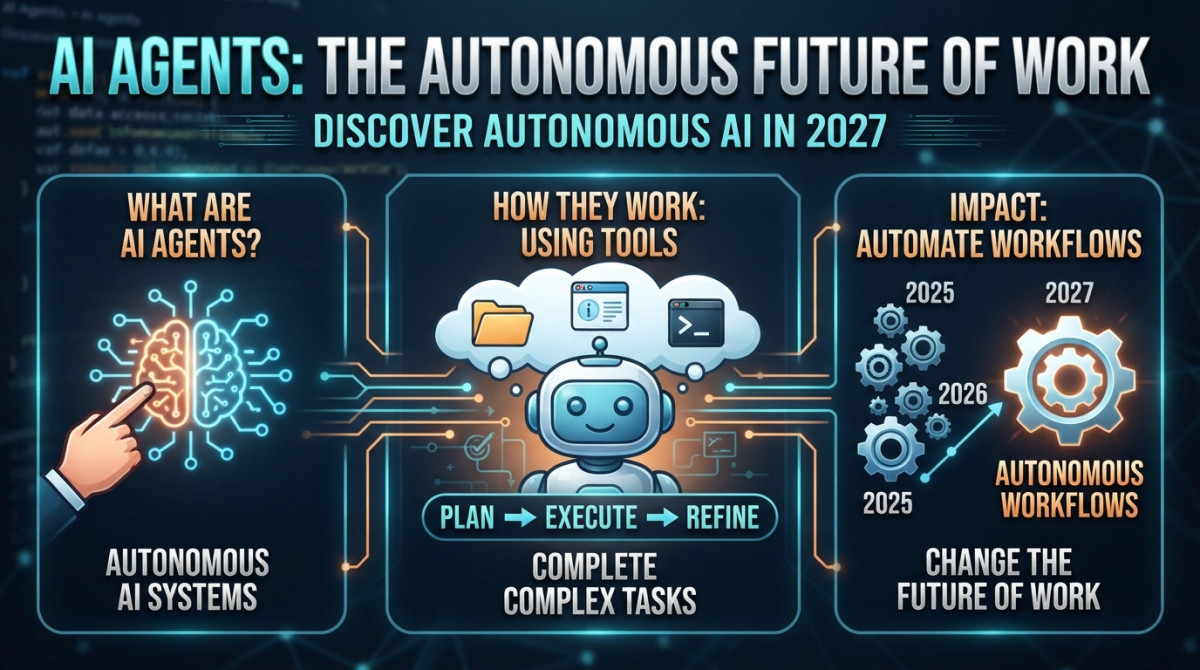
Imagine asking an artificial intelligence system to organize a business meeting.
A conventional chatbot might suggest an agenda, write an invitation, and recommend a meeting schedule. You would still need to open your calendar, check availability, contact participants, create the event, and send the invitations yourself.
An AI agent could potentially handle much more of that process.
With appropriate permissions and connected tools, it could review available calendars, identify a suitable time, prepare the invitation, create the event, and report what it completed. Some actions might require your approval before they happen.
That difference is at the center of one of the most important developments in artificial intelligence.
AI is moving beyond systems that simply generate answers toward systems that can help carry out tasks.
These systems are commonly called AI agents.
The idea is attracting attention because it changes what people expect from software. Instead of opening several applications and manually completing every step, users may increasingly describe an objective and allow an AI system to coordinate parts of the process.
Businesses could use agents to organize customer requests, prepare reports, research information, and manage repetitive workflows. Individuals might use them to organize schedules, compare options, manage documents, and complete routine digital tasks.
However, AI agents are not magical digital employees. They can misunderstand instructions, make incorrect decisions, interact with software in unexpected ways, and require careful supervision.
So what exactly are AI agents, how do they work, and why could they become more important in 2027?
What Are AI Agents?
An AI agent is a software system that uses artificial intelligence to pursue a goal by interpreting instructions, deciding what steps to take, and using available tools or systems to perform tasks.
Unlike a basic question-and-answer chatbot, an agent can participate in a multi-step process.
For example, a user might ask an AI agent to research three software products and prepare a comparison report.
Depending on its capabilities and permissions, the agent could:
-
Understand the requested comparison.
-
Search for relevant product information.
-
Visit approved websites or retrieve documents.
-
Extract important features and prices.
-
Compare the available information.
-
Organize the findings.
-
Prepare a report for the user.
-
Identify information that could not be verified.
The important distinction is that the AI is not simply producing one response. It is coordinating several actions toward a defined objective.
The Organisation for Economic Co-operation and Development (OECD) describes agentic AI through characteristics such as autonomy, goal-directed behavior, and the ability to perceive and act within an environment.
In practical terms, an AI agent combines an AI model with instructions, tools, and a process for deciding what to do next.
Not every application that includes AI is an agent. A system that only generates text in response to a prompt may be useful AI software, but it does not necessarily qualify as an autonomous agent.
AI Agents vs. Traditional Chatbots: What Is the Difference?
The terms chatbot and AI agent are sometimes used interchangeably, but they describe different capabilities.
A traditional chatbot is generally designed to respond to user messages. It may answer questions, provide information, and guide users through predefined conversations.
An AI agent can go further by using tools and interacting with other systems to complete tasks.
Consider the following example.
You want to arrange a business trip.
A traditional chatbot might:
-
Suggest suitable destinations.
-
Recommend hotels.
-
Explain transportation options.
-
Draft a travel itinerary.
An AI agent with appropriate integrations might:
-
Research destinations.
-
Compare available flights.
-
Check hotel options.
-
Organize the itinerary.
-
Add approved events to a calendar.
-
Prepare booking details.
-
Request confirmation before making a purchase.
The second system is doing more than providing advice. It is taking actions through connected services.
| Capability | Traditional chatbot | AI agent |
|---|---|---|
| Answer questions | Yes | Yes |
| Generate text | Yes | Yes |
| Follow a multi-step task | Usually limited | Designed for this |
| Use external tools | Sometimes | Common capability |
| Interact with software | Usually limited | Possible with permissions |
| Adapt to changing information | Depends on the system | Can be built to adapt |
| Complete tasks independently | Usually limited | Possible within defined boundaries |
| Require human supervision | Depends on use | Important for consequential actions |
This is a general comparison rather than a strict technical rule. Modern chatbots can also use tools, and some agents operate with very limited autonomy.
The real distinction is how the system manages the workflow and whether it can take actions toward completing a goal.
How Do AI Agents Work?
An AI agent typically combines several components that allow it to understand a task, choose actions, interact with tools, and evaluate results.
The exact architecture varies depending on the application, but the following components are common.
1. The AI Model
The AI model provides the system's language understanding, reasoning, and decision-making capabilities.
It interprets instructions, understands relevant context, and helps determine what should happen next.
For example, if someone asks an agent to prepare a weekly sales report, the model needs to understand what information is required and which steps might be necessary.
2. Instructions and Goals
An agent needs a clearly defined objective.
A vague instruction such as "help my business grow" is difficult to translate into reliable actions.
A more specific objective could be:
"Review this month's sales spreadsheet, identify the five highest-selling products, compare them with the previous month, and prepare a summary."
Clear instructions help define what success looks like and what the agent should avoid doing.
3. Tools and Integrations
Tools give an agent the ability to interact with its environment.
Depending on its configuration, an agent might have access to:
-
Web search.
-
Email systems.
-
Calendar applications.
-
Spreadsheets.
-
Databases.
-
Customer relationship management software.
-
Document storage.
-
Business applications.
-
APIs and other software services.
An agent cannot automatically access every application. It needs an available integration, appropriate permissions, and a supported way to perform the requested action.
4. Planning and Task Execution
An agent may divide a larger objective into smaller steps.
For example, preparing a competitor research report might involve identifying competitors, collecting public information, comparing products, organizing findings, and writing a summary.
The system can decide which action to perform next based on the available information.
Some agents follow predefined workflows. Others can choose between available tools and adjust their approach when they encounter new information.
5. Memory and Context
Some AI agents maintain information across multiple steps or sessions.
This may include task progress, previous instructions, relevant documents, user preferences, or results from earlier actions.
Memory is useful when an agent needs to continue a project without repeatedly asking the user for the same information.
However, memory must be managed carefully. Outdated information, incorrect assumptions, or inappropriate data retention can create problems.
6. Evaluation and Guardrails
An agent needs ways to recognize errors, handle unexpected situations, and stop when it cannot safely continue.
Guardrails can restrict certain actions, validate inputs, and check outputs.
Human approval can also be required before sensitive actions, such as sending an external message, changing important records, making a payment, or deleting information.
A reliable agent should not simply keep acting until it produces an answer. It should also recognize when it needs assistance or permission.
A Simple Example: How an AI Agent Completes a Task
Imagine a small business owner wants to understand why sales declined during the previous month.
Instead of manually reviewing several spreadsheets, the owner asks an AI agent to investigate.
Here is how a possible workflow could operate.
Step 1: Understand the objective
The agent identifies that it needs to compare recent sales with an earlier period.
Step 2: Retrieve the information
It accesses approved sales reports or spreadsheets.
Step 3: Analyze the data
It compares revenue, product categories, sales volume, and relevant time periods.
Step 4: Identify patterns
It notices that several product categories experienced declining sales.
Step 5: Investigate further
If authorized, it checks related information such as inventory records or marketing campaign performance.
Step 6: Prepare a report
It creates a summary explaining the observed patterns and possible factors worth investigating.
Step 7: Ask for human review
The owner reviews the report before making decisions about pricing, inventory, or marketing.
The agent helps organize the investigation, but it does not automatically know why customers changed their purchasing behavior.
The business owner still needs to consider market conditions, customer feedback, competition, and other evidence.
10 Ways AI Agents Could Be Used in Everyday Life and Business
AI agents are relevant because many everyday activities involve multiple applications and repeated steps.
Here are ten practical areas where they could make a difference.
1. Managing Emails and Communication
An AI agent could organize incoming messages, summarize long conversations, identify important requests, and prepare suggested replies.
For example, a freelancer receiving dozens of client emails might use an agent to separate new project inquiries from existing customer support requests.
It could also prepare draft responses based on approved business information.
Sending messages automatically should require appropriate permissions and review rules, particularly when the communication involves contracts, financial commitments, or sensitive information.
2. Organizing Meetings and Calendars
Calendar management often involves checking availability, contacting participants, selecting times, and preparing invitations.
An AI agent connected to an approved calendar could help coordinate these steps.
It might identify available time slots, draft meeting invitations, and create calendar events after receiving the necessary authorization.
This could be useful for consultants, remote teams, managers, and people who coordinate several schedules.
3. Researching Information
Research often requires collecting information from different sources and organizing it into a useful format.
An AI agent could search approved websites, retrieve documents, compare information, and prepare a summary.
For example, a marketing team might ask an agent to research public information about a new industry trend.
The agent could organize the findings into a report with source links, dates, and areas where further verification is needed.
The quality of the report still depends on source reliability and the agent's ability to distinguish confirmed facts from uncertain claims.
4. Supporting Customer Service
Customer service agents could help businesses manage routine requests.
A customer might ask about delivery status, product information, operating hours, or return procedures.
An AI agent connected to approved company systems could retrieve relevant information and provide an answer.
More complicated requests could be transferred to a human employee.
This approach could help businesses respond faster while keeping human staff available for situations requiring judgment or empathy.
5. Supporting Online Shopping
An AI shopping agent could help customers compare products based on their requirements.
For example, someone looking for a laptop might provide a budget, preferred screen size, and intended use.
The agent could compare suitable products, review specifications, identify differences, and prepare recommendations.
If connected to shopping services, it might also help organize a purchase.
However, purchasing should require clear authorization. The agent should not place an order or spend money without the user's approval.
6. Helping With Business Administration
Small businesses often spend significant time organizing documents, preparing reports, tracking tasks, and coordinating internal processes.
An AI agent could help collect information from approved systems and prepare administrative summaries.
A service business might use one to organize incoming requests, prepare task lists, and notify employees when a new job requires attention.
This is especially relevant for businesses that do not have large administrative teams.
7. Assisting With Software Development
AI agents are also becoming useful in software development.
Depending on their configuration, coding agents can inspect codebases, explain existing code, suggest changes, run tests, identify errors, and prepare proposed code modifications.
A developer might ask an agent to investigate why a particular feature is not working.
The agent could inspect relevant files, trace the problem, suggest a fix, and run tests in an approved development environment.
Human developers still need to review code, test the results, and control changes to production systems.
8. Organizing Personal Tasks
Individuals could use AI agents to coordinate routine activities.
For example, an agent might help organize a weekly schedule, prepare a shopping list, summarize reminders, and arrange tasks according to deadlines.
More advanced systems may connect with calendars, notes, and other applications.
The goal is to reduce the amount of manual coordination people perform throughout the day.
9. Supporting Education and Learning
Students could use AI agents to organize study plans, locate learning resources, prepare practice questions, and track progress.
A student studying a new subject might ask an agent to develop a weekly learning schedule based on available time and specific learning goals.
The agent could also organize notes and suggest topics that need more attention.
However, students should use these systems to support learning rather than submit generated work as their own or rely on unverified explanations.
10. Coordinating Travel Plans
Travel planning can involve several separate activities: researching destinations, comparing transportation, checking accommodation, understanding entry requirements, and preparing itineraries.
An AI agent could help coordinate these activities.
For example, it might compare destinations based on a budget, research transportation options, organize hotel information, and prepare a day-by-day itinerary.
Travelers should verify current prices, booking conditions, visa requirements, and safety information through reliable sources.
An agent should also obtain approval before making reservations or purchases.
What Are Multi-Agent AI Systems?
Some tasks are too complicated for one AI agent to handle efficiently.
This has led to the development of multi-agent systems, where several specialized agents work together.
Imagine a company wants to prepare a market research report.
Instead of asking one agent to perform every task, the company could organize a system with different responsibilities:
-
Research agent: Collects information from approved sources.
-
Analysis agent: Examines the collected information.
-
Fact-checking agent: Identifies unsupported or inconsistent claims.
-
Writing agent: Organizes the findings into a report.
-
Coordinator agent: Manages the workflow and prepares the final result.
Each agent has a specific role and may use different tools.
The coordinator can assign tasks, collect results, and decide when the workflow is ready for review.
This is sometimes called agent orchestration.
There are different ways to coordinate agents. In one approach, a central agent delegates tasks to specialist agents while retaining responsibility for the final result. In another, one agent hands control to another specialist when a particular task requires different capabilities.
Multi-agent systems can make complex workflows more organized, but adding more agents does not automatically improve results.
Every additional component can introduce more opportunities for communication errors, duplicated work, inconsistent information, and increased cost.
A well-designed system uses multiple agents only when their separate responsibilities provide a genuine benefit.
AI Agents vs. Traditional Automation: Are They the Same?
AI agents and traditional automation both aim to reduce manual work, but they operate differently.
Traditional automation generally follows predefined rules.
For example, a business might create a workflow:
-
When an order is received, record it.
-
When payment is confirmed, update the order status.
-
When the order is shipped, send a notification.
This process works well because the steps are predictable.
An AI agent can handle situations that require interpreting information or choosing between possible actions.
For example, it might review an incoming customer message, identify the nature of the request, retrieve relevant information, and decide which approved workflow should handle it.
| Feature | Traditional automation | AI agents |
|---|---|---|
| Main approach | Predefined rules | Goal-directed decisions |
| Best for | Repetitive predictable tasks | Tasks requiring interpretation |
| Adaptability | Limited to programmed rules | Can adapt within defined capabilities |
| Decision-making | Rule-based | AI-assisted |
| Tool interaction | Predetermined integrations | May select tools dynamically |
| Predictability | Often highly predictable | Requires evaluation and oversight |
| Setup | Rules and workflow design | Instructions, tools, permissions, and controls |
Neither approach is universally better.
A business should use traditional automation when a simple, predictable workflow is sufficient. AI agents are more useful when a process requires understanding language, interpreting context, or adapting to changing information.
In many cases, the strongest solution combines both.
What Are the Benefits of AI Agents?
AI agents could change how individuals and organizations manage digital work.
Their potential benefits include the following.
Less Repetitive Work
Agents can help coordinate activities that otherwise require repeatedly switching between applications.
This may reduce time spent on administrative tasks, information collection, and routine communication.
Faster Task Completion
An agent with suitable integrations can perform multiple steps without requiring a person to manually initiate each one.
The actual time saved depends on task complexity, tool reliability, and how much review is required.
Better Coordination
Agents can help organize information from different sources and coordinate tasks across connected systems.
This can be valuable for businesses managing several applications and departments.
More Accessible Technology
Small organizations may be able to access capabilities that previously required specialized software or larger technical teams.
However, implementation, integration, and ongoing supervision still involve costs.
Support for Decision-Making
Agents can collect information, summarize data, and highlight patterns that people might otherwise overlook.
They should support decisions rather than replace accountability for important business choices.
More Flexible Workflows
Unlike strictly predefined automation, some agents can adjust their actions when they encounter new information or unexpected conditions.
This flexibility can be useful, but it also makes careful testing and supervision important.
What Are the Risks and Limitations of AI Agents?
The ability to take action makes AI agents potentially more useful, but it also creates additional risks.
An incorrect answer from a chatbot can be misleading. An incorrect action from an agent could affect a business record, send a message, change a document, or create a financial consequence.
1. Incorrect Decisions
AI agents can misunderstand instructions, misinterpret information, or select an inappropriate action.
They may also produce convincing explanations for conclusions that are not supported by evidence.
Important results should be checked before being used.
2. Excessive Permissions
An agent with access to email, customer records, financial systems, and business applications could create serious problems if its permissions are too broad.
Businesses should give agents only the access needed for their assigned tasks.
For example, an agent that summarizes invoices may not need permission to approve payments.
3. Data Privacy
Agents may process personal, financial, commercial, or confidential information.
Businesses need to understand where data is stored, who can access it, how long it is retained, and whether third-party providers use it for other purposes.
4. Security Threats
AI agents can be exposed to malicious instructions hidden in documents, emails, websites, or other external content.
This is related to a security issue known as prompt injection.
For example, an agent researching a webpage might encounter text designed to make it ignore its original instructions or reveal information it should not access.
Systems need protections that separate untrusted content from authorized instructions and restrict what actions an agent can take.
5. Unintended Actions
An agent might send an incomplete email, update the wrong record, create a duplicate event, or misunderstand a request.
Human approval should be required for sensitive or difficult-to-reverse actions.
6. Unpredictable Costs
AI services may charge based on usage, model calls, integrations, or other factors.
Complex workflows can consume more resources than expected, especially when agents repeatedly retry tasks or call multiple tools.
Businesses should monitor usage and establish spending limits.
7. Difficulty Measuring Performance
A workflow may appear successful because an agent completed its steps, even if the final result is inaccurate or incomplete.
Organizations need to evaluate the quality of outcomes, not merely the number of tasks completed.
How to Use AI Agents Safely
Organizations considering AI agents should introduce them gradually.
A responsible implementation starts with a clearly defined task and limits the system's ability to cause harm.
Here are seven practical principles.
1. Start with low-risk tasks.
Begin with research summaries, document organization, draft preparation, or internal reporting before allowing agents to perform consequential actions.
2. Define clear permissions.
Give agents access only to the information and tools they genuinely need.
3. Require approval for important actions.
Sending external communications, making purchases, deleting information, changing important records, and approving payments should have appropriate review requirements.
4. Keep records of actions.
Maintain logs showing what the agent accessed, which tools it used, what actions it attempted, and what results it produced.
5. Test unusual situations.
Check how the system responds to incomplete instructions, conflicting information, missing data, and malicious external content.
6. Protect sensitive information.
Establish rules about which documents, customer records, and business information can be shared with AI services.
7. Provide a human escalation path.
The agent should be able to stop and ask for help when it cannot safely complete a task.
The goal is not to remove human involvement from every process. It is to allow AI to handle suitable tasks while keeping people responsible for important decisions.
Are AI Agents Going to Replace Human Workers?
This is one of the biggest questions surrounding agentic AI.
If an AI system can research information, organize documents, respond to messages, and complete multi-step digital tasks, it is reasonable to ask what happens to the people who currently perform those activities.
The answer is not simple.
AI agents may automate portions of existing jobs, change the skills employers value, and reduce the time required for certain tasks.
For example, an administrative employee might spend less time preparing routine summaries and more time coordinating complex requests. A software developer could delegate parts of code investigation while focusing more on system design and testing.
Some roles may change significantly, while others may experience limited effects.
The impact will depend on the industry, quality of the technology, cost of implementation, regulation, and the nature of the work.
Human abilities such as judgment, empathy, negotiation, accountability, creativity, and relationship-building remain important in many professional situations.
The more useful question may be how people and AI agents can work together effectively.
How Small Businesses Can Start Using AI Agents in 2027
Small businesses do not need to build complicated multi-agent systems to begin experimenting.
A sensible starting point is to identify one workflow that creates unnecessary administrative work.
For example, a small consulting company might receive project inquiries through its website.
A basic agent-assisted workflow could:
-
Read an incoming inquiry.
-
Categorize the request.
-
Extract the customer's preferred contact information.
-
Summarize the project requirements.
-
Create a draft response.
-
Notify the appropriate employee.
-
Wait for approval before sending the response.
This is a manageable use case because the agent helps organize information without independently making business commitments.
Other possible starting points include:
-
Summarizing internal meetings.
-
Organizing incoming customer requests.
-
Preparing weekly business reports.
-
Researching publicly available market information.
-
Organizing project documentation.
-
Drafting routine customer communications.
Businesses should compare the cost and reliability of an AI agent with ordinary workflow automation before choosing a solution.
Sometimes a simple automated rule is cheaper, safer, and easier to maintain.
What Could the Future of AI Agents Look Like in 2027 and Beyond?
The development of AI agents points toward a different relationship between people and software.
For decades, users have generally needed to understand which application to open, which buttons to press, and which steps to follow to complete a task.
AI agents could gradually change that interaction.
Instead of navigating several applications manually, a user may increasingly describe an outcome and allow an AI system to coordinate the necessary steps.
Several developments are worth watching.
Agents That Work Across Multiple Applications
Agents may increasingly connect with calendars, email, databases, document platforms, and business software.
This could make it easier to coordinate work that currently requires switching between different applications.
More Specialized Agents
Rather than relying on one general-purpose system, businesses may use specialized agents for research, customer service, finance administration, software development, and internal operations.
Better Human-Agent Collaboration
Future systems may offer more useful ways to review actions, approve decisions, monitor progress, and intervene when something goes wrong.
Trust and transparency will be essential if agents are expected to handle important tasks.
More Personal and Context-Aware Assistance
Agents may become better at using relevant preferences, documents, and task history to provide continuity across repeated workflows.
This will make privacy, user control, and data management increasingly important.
Stronger Security and Governance
As agents gain access to more systems, organizations will need stronger permission controls, monitoring, testing, and security procedures.
The success of agentic AI will depend not only on how much agents can do, but also on whether people can understand and control what they do.
Conclusion: The Next Stage of AI Is About Getting Things Done
Artificial intelligence has already changed how people search for information, write documents, create content, and communicate with technology.
AI agents introduce another possibility.
Instead of simply helping people decide what to do, they can increasingly help carry out the steps required to complete a task.
That could make a meaningful difference to businesses, professionals, students, developers, and ordinary users.
But greater capability also brings greater responsibility. Agents need clear instructions, restricted permissions, reliable tools, and human oversight where mistakes could have serious consequences.
The future of AI will not be measured only by how intelligent a model appears in a conversation. It will also depend on how reliably it performs useful work, how safely it interacts with the world, and how much control people retain over its actions.
The next major shift in artificial intelligence may not be about getting better answers. It may be about getting more of the work done—with humans still deciding what matters.
Frequently Asked Questions
What's Your Reaction?
 Like
0
 Dislike
0
 Love
0
 Funny
0
 Wow
0
 Sad
0
 Angry
0















Comments (0)