

The Second-Life Economy: Why Repairing, Reusing, and Restoring Things Could Become the New Luxury
The second-life economy is changing how people think about ownership. From repairing electronics and restoring furniture to buying refurbished products, this article explores the growing value of extending the life of everyday possessions and the opportunities it creates for consumers and businesses.

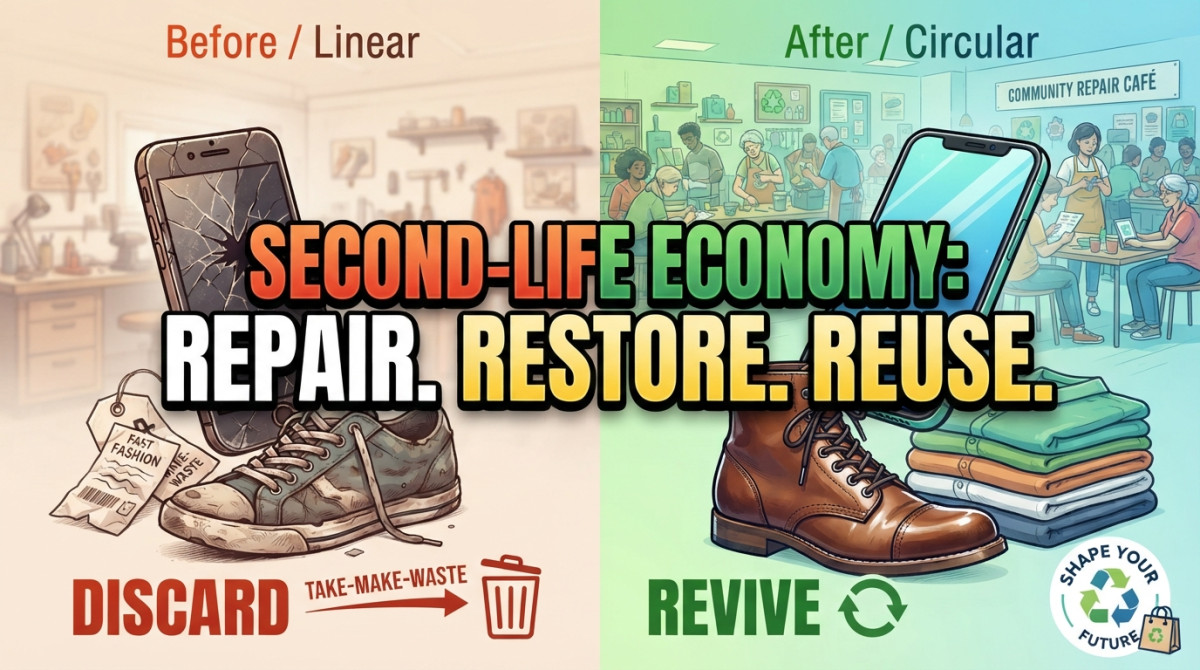
A phone stops working. A chair loses a leg. A jacket develops a tear. A kitchen appliance suddenly refuses to turn on.
For many people, the first question is no longer whether the item can be repaired. It is how much a replacement will cost and how quickly a new one can arrive.
We have become accustomed to replacing things.
New products appear constantly, online stores offer endless choices, and advertisements encourage us to upgrade even when what we already own still works. Convenience has made buying something new easier than finding someone who can fix the old one.
But an interesting change is beginning to emerge.
Some consumers are rediscovering secondhand shopping, refurbished electronics, furniture restoration, clothing repair, and the satisfaction of keeping useful possessions for longer.
This is more than nostalgia for an older way of living. It represents an economic opportunity.
Welcome to the second-life economy: a way of thinking about products in which their value does not end when the first owner finishes using them.
The idea challenges a familiar assumption that new automatically means better. It asks whether a product can create value for a second, third, or even fourth owner—and whether businesses can make money by extending the useful life of things rather than constantly selling replacements.
The answer could reshape how we shop, manufacture, repair, and build businesses.
1. The hidden cost of always buying something new
Modern consumer culture has made replacement remarkably convenient.
A person can order a new phone in minutes, replace a broken household appliance through an online marketplace, or purchase a new outfit without leaving home.
But the price displayed on a product page does not tell the whole story.
Every newly manufactured product requires materials, energy, labor, transportation, packaging, and distribution. Some products also contain components that are difficult to separate, repair, or recycle.
When an item is discarded prematurely, the resources used to manufacture it may provide only a fraction of their potential value.
Consider a simple example.
A wooden table might have a damaged surface, loose joints, or an outdated finish. Its structure may still be perfectly usable. Throwing it away and purchasing another table creates additional demand for materials and manufacturing.
Restoring the original table could preserve much of its value with considerably less material.
The same principle applies to clothing, electronics, bicycles, appliances, and countless other products.
The problem is not that people should never purchase new things. New products are sometimes necessary, safer, more efficient, or more practical.
The problem is treating replacement as the automatic response to every small failure.
2. Repairing things is becoming an economic opportunity
Repairing used to be an ordinary part of household life.
People visited local tailors, watchmakers, cobblers, mechanics, carpenters, and appliance technicians. Many communities had specialists who could repair almost anything.
In some places, these services have become harder to find or more expensive relative to buying replacements.
Yet this creates an opportunity for a new generation of repair-focused businesses.
Imagine a neighborhood business that specializes in repairing smartphones, restoring old furniture, replacing appliance components, cleaning and repairing sneakers, or giving old clothing a second life.
These businesses do not necessarily need to manufacture new products. Their value comes from preserving the usefulness of products that already exist.
The business model can also be flexible.
A repair shop might charge for individual services, sell refurbished products, offer maintenance packages, or partner with retailers that want to provide after-sales repair services.
A furniture restoration business could purchase damaged pieces, repair them, and resell them at a higher price.
A clothing business might offer alterations, visible mending, customization, and restoration.
The second-life economy does not eliminate entrepreneurship. It creates different kinds of entrepreneurship.
3. The rise of products with more than one owner
A product's first owner is not necessarily its final owner.
A laptop that one person no longer needs could be useful to a student. A camera that a professional photographer has replaced might become an affordable option for a beginner. A bicycle that has been sitting unused in a garage could become someone's daily transportation.
This is the logic behind the resale and refurbished-product markets.
The original buyer receives some value back, while the next buyer gains access to a product at a lower price than a new equivalent.
Businesses can add value by inspecting, cleaning, repairing, testing, grading, and reselling used products.
However, there is an important distinction between secondhand and refurbished.
A secondhand product may simply be resold in its existing condition. A refurbished product should have undergone some form of inspection and restoration, although the exact standards vary between sellers.
That difference matters.
Customers need to know whether a product has been tested, whether its components have been replaced, whether it includes a warranty, and what condition it is actually in.
Trust is one of the most important assets in the second-life economy.
4. Why buying used could become a sign of smart consumption
For a long time, buying secondhand was sometimes associated with financial limitations.
That perception is changing.
A person may choose a refurbished laptop because it offers the performance they need without the price of a new model. Someone may purchase vintage furniture because they prefer its craftsmanship and character. Another person might buy pre-owned clothing because they want a distinctive style.
These choices are not necessarily about having less money.
They can be about making a more deliberate decision.
The value of a purchase increasingly depends on more than its packaging or release date. Buyers may consider durability, repairability, resale value, materials, performance, and how long the product will remain useful.
A product that lasts ten years may represent better value than a cheaper product that needs frequent replacement.
The same reasoning applies to clothing, tools, furniture, and household equipment.
The second-life economy encourages consumers to ask a different question:
Instead of asking, "What is the newest thing I can buy?" perhaps we should ask, "What is the most useful thing I can own?"
5. Technology could make repairing products easier
One reason the second-life economy has potential is that technology can help connect people who own unwanted products with people who need them.
Digital marketplaces already make it easier to sell used electronics, furniture, clothing, vehicles, and household goods.
But the next opportunity may involve more specialized platforms.
Imagine an online service where a customer enters the model of a broken appliance, describes the problem, and receives a list of nearby repair professionals who work with that product.
Another platform could help people identify replacement components, compare repair costs, and find authorized service centers.
Artificial intelligence could assist with preliminary troubleshooting, product identification, repair documentation, and matching customers with relevant services.
For example, a customer might upload a photograph of a damaged chair and receive an initial explanation of the likely repair options. A qualified carpenter could then inspect it and provide an accurate estimate.
Such systems would not replace professional inspection or technical expertise. They could make the process of finding help less confusing.
Technology could also improve product histories.
Digital records showing a product's ownership, maintenance, repairs, and component replacements could make some secondhand purchases more transparent.
This would be especially valuable for expensive electronics, vehicles, industrial equipment, and specialized machinery.
6. The business opportunity hidden in local communities
One of the most interesting features of the second-life economy is that it can create opportunities close to where people live.
Not every business needs to operate internationally or manufacture products at scale.
A local entrepreneur could build a business around a specific category of products.
Consider these possibilities:
Electronics restoration: Repairing smartphones, laptops, tablets, and gaming devices, then selling inspected refurbished products.
Furniture restoration: Finding unwanted furniture, repairing structural damage, refinishing surfaces, and selling restored pieces.
Clothing repair: Offering alterations, zipper replacement, tailoring, embroidery, and creative clothing restoration.
Appliance maintenance: Providing inspection and repair services for washing machines, refrigerators, ovens, and other household equipment.
Sports equipment resale: Inspecting, cleaning, repairing, and reselling bicycles, camping equipment, fitness products, and outdoor gear.
Tool-sharing services: Renting or sharing tools that customers need occasionally rather than purchasing and storing them.
These businesses can begin with a focused service and gradually expand.
However, they still require careful planning. Repair businesses must understand labor costs, spare-parts availability, warranties, liability, customer expectations, and the economics of each repair.
Not every damaged product is worth restoring.
A successful business must know when repair creates value and when replacement is genuinely the better option.
7. Why manufacturers may eventually need to rethink their products
The second-life economy also challenges manufacturers.
Many businesses traditionally focus on selling new units. Their products are designed around manufacturing costs, features, distribution, and customer demand.
But consumers and regulators are increasingly paying attention to repairability, durability, access to spare parts, and product lifecycles.
This creates pressure to rethink product design.
A product that can be opened, inspected, repaired, and upgraded may remain useful for longer.
A manufacturer could offer replacement components, repair manuals, maintenance programs, or official refurbishment services.
It could also create a resale program in which used products are collected, restored, and sold again.
This may sound like a threat to companies that depend on frequent replacement purchases.
But it can also create new revenue streams.
A company that earns money from maintenance, repair, replacement parts, refurbishment, and resale is not relying exclusively on selling a new product every time a customer needs something.
The relationship with the customer can continue throughout the product's life.
8. The right-to-repair movement and changing expectations
Repairability is not only a consumer preference. It has also become a subject of public policy.
The right-to-repair movement argues that consumers and independent repair professionals should have reasonable access to the tools, parts, information, and software needed to repair products.
The details differ across jurisdictions and product categories.
In the European Union, several measures have been introduced to improve repair opportunities and product durability. The EU's Right to Repair Directive, adopted in 2024, is intended to strengthen consumers' ability to obtain repairs for covered products.
In the United States, right-to-repair debates have developed through state laws, federal policy discussions, and disputes involving manufacturers and independent repair providers.
These developments reflect a broader shift in expectations.
When people purchase an expensive product, they increasingly want to know what happens when it breaks.
Can they replace the battery? Can an independent technician repair it? Are spare parts available? Will a software restriction prevent a perfectly usable component from working?
These questions can influence purchasing decisions.
For manufacturers, designing products with repairability in mind may become an increasingly important competitive advantage.
9. The second-life economy is not automatically sustainable
There is an important warning.
Buying secondhand or repairing something does not automatically make every decision environmentally beneficial.
A poorly repaired product may fail again quickly. Transporting inexpensive secondhand items over long distances can create additional emissions. Some refurbished electronics may still contain damaged batteries or components that create safety risks.
And recycling is not the same as reuse.
Recycling processes materials so they can be used again. Reuse keeps an existing product or component in service, often preserving more of the work and resources already invested in it.
The best option depends on the product, its condition, the repair required, and the available alternatives.
Consumers should also be cautious about sellers who use words such as "refurbished," "renewed," or "like new" without explaining what they mean.
A responsible second-life market needs transparent product descriptions, competent repairs, safe components, fair warranties, and realistic expectations.
Otherwise, it risks becoming another marketing trend rather than a meaningful economic change.
10. A different definition of luxury
Luxury has traditionally been associated with exclusivity, expensive materials, famous brands, and products that communicate status.
But another idea of luxury is becoming easier to imagine.
A well-made wooden table that has survived several generations. A repaired watch that continues to work decades after it was purchased. A jacket that has been carefully restored instead of discarded. A laptop that remains useful because its components can be upgraded.
These objects carry something that a brand-new purchase cannot always provide: history.
They also demonstrate that value is not necessarily connected to novelty.
This does not mean every old product is better than a new one. Some products become unsafe, inefficient, or impossible to repair economically.
But it does suggest that durability and craftsmanship deserve more attention.
Perhaps the next expression of thoughtful consumption will not be owning the newest version of everything.
It will be owning things that remain useful long enough to become part of our lives.
11. How consumers can participate in the second-life economy
People do not need to become repair experts or stop buying new products to participate.
A few practical habits can make a difference.
-
Check repair options before replacing something. Ask a qualified technician whether the item can be repaired safely and economically.
-
Look for refurbished alternatives. For electronics and appliances, check the seller's inspection standards, warranty, and return policy.
-
Choose durable products. Consider materials, repairability, spare-parts availability, and expected lifespan.
-
Sell or donate usable possessions. An item that no longer serves one household may be valuable to another.
-
Learn basic maintenance. Cleaning, proper storage, and routine servicing can help extend the useful life of many products.
-
Support skilled local businesses. Tailors, repair technicians, cobblers, mechanics, and restoration specialists provide services that keep products in use.
-
Avoid unnecessary upgrades. If a product still meets your needs, replacing it simply because a newer version exists may not provide meaningful value.
The objective is not to avoid consumption completely. It is to make consumption more thoughtful.
12. The future may reward businesses that help things last longer
The second-life economy is not likely to replace conventional manufacturing or retail.
People will continue to need new products. Technology will advance, safety standards will change, and some goods will eventually reach the end of their useful lives.
But the relationship between buying, using, repairing, and replacing products may become more balanced.
Manufacturers could build products that are easier to maintain. Retailers could offer certified resale programs. Repair professionals could use digital tools to find customers. Consumers could make purchasing decisions based on lifetime value rather than only the initial price.
The opportunities are not limited to wealthy countries.
Communities with strong repair traditions already demonstrate how valuable local technical skills can be. Better access to spare parts, training, and digital marketplaces could help these businesses reach more customers.
The biggest challenge will be making repair and reuse convenient, trustworthy, and economically practical.
If buying a new product takes five minutes but finding a reliable repair professional takes five days, many people will continue choosing replacement.
The businesses that make the second option easier could have an important role in the next generation of consumer markets.
Conclusion: Maybe the most valuable thing is the thing we already own
We live in a world that constantly encourages us to upgrade.
New phones, new furniture, new clothing, new appliances, and new versions of products appear before we have finished using the previous ones.
But value does not always come from starting again.
Sometimes it comes from preserving what already works, repairing what can be fixed, and finding a new purpose for what someone else no longer needs.
The second-life economy challenges the idea that every purchase must begin with something brand new.
It creates opportunities for small businesses, gives consumers more choices, encourages better product design, and makes durability a more visible part of the conversation about value.
Perhaps the future of consumption will not be defined only by how much we can produce and purchase.
It may also be defined by how intelligently we use what we already have.
And in a world that has become very good at selling us the next new thing, knowing how to give an old thing another life could become a valuable skill.
Frequently Asked Questions
What's Your Reaction?
 Like
0
 Dislike
0
 Love
0
 Funny
0
 Wow
0
 Sad
0
 Angry
0











Comments (0)