

The Business of Being in the Sky: Why Every Airline Sells a Different Kind of Flying Experience
Airlines may take passengers to the same destination, but the experience can be completely different. From economy seats and luxury suites to onboard dining, cabin crew service, loyalty programs, and hidden revenue streams, discover the business strategies that shape how airlines sell the experience of flying.

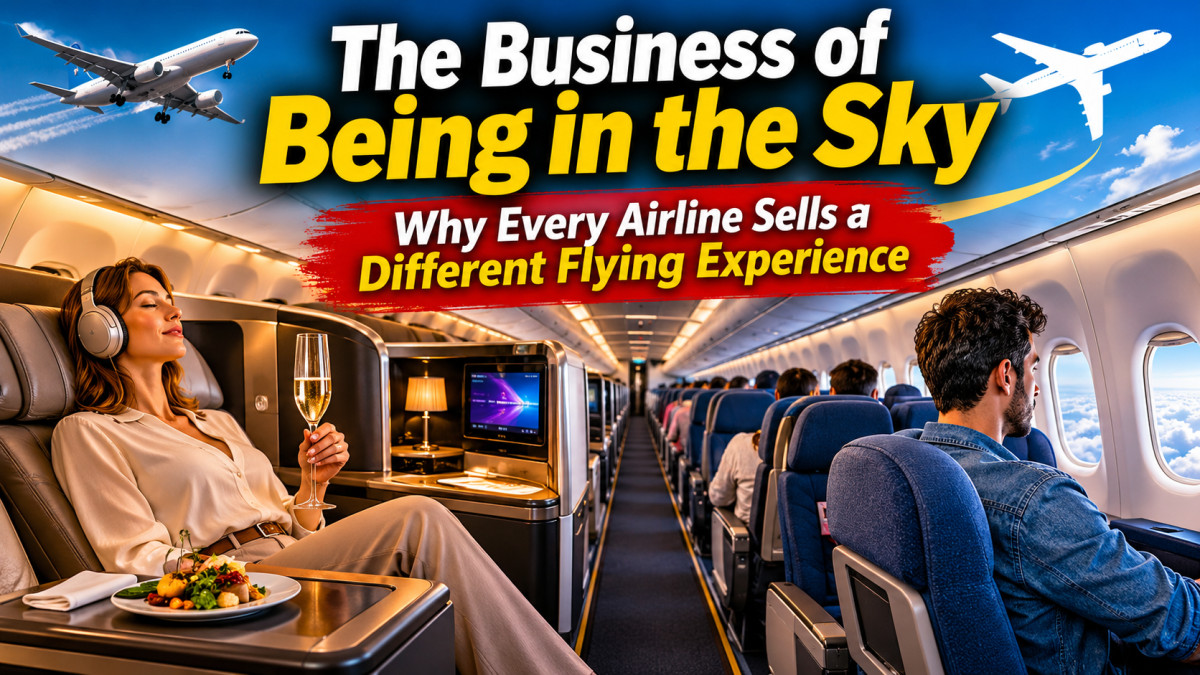
Imagine boarding two different flights to the same destination.
On the first aircraft, you enter through a spacious door, are welcomed by a crew member, receive a warm towel, choose from a restaurant-style menu, and settle into a seat that transforms into a comfortable bed. Someone offers you a drink before takeoff, and your luggage receives special attention.
On the second aircraft, you find your assigned seat, place your bag in the overhead compartment, and wait for departure. A drink or snack may be available, but some items come with an additional charge. You have paid considerably less, and the airline's main promise is straightforward: it will get you to your destination.
Both aircraft fly through the same sky. Both require trained pilots, maintenance, fuel, airport facilities, and strict safety procedures. Yet the experience can feel as if the passengers are travelling through two entirely different worlds.
Why?
Why does one airline serve champagne while another sells a small bottle of water? Why do some airlines provide enormous business-class seats while others concentrate on affordable economy travel? Why do certain airlines build their entire identity around luxury, while others compete by making tickets as inexpensive as possible?
And perhaps the most interesting question: Is the airline selling transportation, or is it selling a particular version of life at 35,000 feet?
The answer is that it is doing both.
The modern airline industry is not simply about moving people between countries. It is a complicated business built around pricing, psychology, customer expectations, comfort, competition, brand identity, and the economics of every available inch of an aircraft.
Let's look behind the cabin door.
1. Every Airline Has a Different Business Philosophy
Not every airline is trying to attract the same passenger.
Some want to become the preferred choice for wealthy international travellers. Others want families to afford holidays, workers to visit their homes, students to travel abroad, and ordinary people to reach destinations without spending a fortune.
This difference begins with the airline's business model.
Full-service airlines: Selling the complete journey
Traditional full-service airlines generally offer several cabin classes, a wider range of onboard services, connecting-flight networks, loyalty programs, and airport facilities.
Their ticket prices may include checked baggage, meals, entertainment, and other services, depending on the route and fare type.
Examples include Singapore Airlines, Qatar Airways, Emirates, Lufthansa, and British Airways.
Their business is not only about selling a seat. They are selling a more complete travel experience, with the exact package depending on the airline and ticket purchased.
Low-cost airlines: Selling transportation at a lower starting price
Low-cost carriers usually focus on controlling operating expenses and offering competitive base fares.
Instead of including every service in the ticket, they may charge separately for checked baggage, seat selection, priority boarding, meals, and other extras.
Examples include Ryanair, easyJet, and Spirit Airlines.
This approach allows passengers to pay for fewer services if they do not need them. Someone travelling with a small bag on a short journey may prefer this arrangement.
However, the advertised ticket price may not represent the final amount a passenger pays after selecting additional services.
Hybrid airlines: Somewhere in between
Some airlines combine elements of both models.
They may offer relatively affordable base fares while also providing premium seats, loyalty benefits, additional baggage options, and selected full-service features.
The distinction is not always absolute. Airline business models can overlap, and the same airline may offer different products on different routes.
The important point is that airlines design their services around the passengers they want to attract and the amount those passengers are willing to pay.
2. Why Does the Same Aircraft Have Different Classes?
<PRIVATE_PERSON> might be sitting in economy while another passenger is enjoying a private suite just a few metres away.
They are on the same aircraft, travelling at the same speed, using the same runway, and arriving at the same airport.
Yet their tickets could have dramatically different prices.
This is one of the most interesting parts of airline economics.
Airlines divide their aircraft into different cabin products because passengers have different priorities and different budgets.
Economy class: The essential journey
Economy class is designed to carry the largest number of passengers on many commercial aircraft.
Its primary purpose is to provide transportation at a price that a broad range of travellers can afford.
Depending on the airline, economy passengers may receive meals, entertainment, baggage allowances, and other services as part of their ticket.
Other airlines offer a more basic product, with selected services available for an additional fee.
Premium economy: A little more personal space
Premium economy sits between standard economy and business class.
It often offers wider seats, additional legroom, more comfortable recline, improved dining, and other benefits.
It is designed for people who want more comfort but do not necessarily need the full business-class experience.
For a long international flight, that additional space can make a meaningful difference.
Business class: Comfort, privacy, and time
Business class is not exclusively for businesspeople.
Although corporate travellers have historically been an important customer group, holidaymakers, couples, families, and people spending their own money also purchase business-class tickets.
Depending on the airline and aircraft, business class may include:
-
Seats that convert into fully flat beds.
-
Direct aisle access.
-
More personal space and privacy.
-
Premium dining and beverage choices.
-
Lounge access.
-
Priority check-in and boarding.
-
Additional baggage allowances.
-
More flexible ticket conditions.
Some airlines have transformed business class into something that looks more like a small hotel room than a traditional aircraft seat.
The interesting business decision is that airlines can earn substantially more from a relatively small number of premium seats.
First class: The luxury product
First class is generally positioned above business class, although not every airline offers it.
Some first-class products include enclosed suites, exceptional dining, private airport facilities, dedicated service, and highly personalised experiences.
For certain airlines, first class is also a brand statement. It tells the world what the company considers the highest level of luxury in commercial aviation.
But there is a business reality behind all these different cabins: every passenger does not need the same product, and airlines do not expect every passenger to pay the same price.
3. The Secret Business Behind Business Class
Here is something that makes airline economics particularly fascinating.
A business-class seat takes up more room than an economy seat. It may even occupy the space that could otherwise accommodate several economy passengers.
So why would an airline deliberately remove potential economy seats to install larger, more expensive ones?
Because revenue is not determined only by how many passengers are on an aircraft.
It also depends on how much each passenger pays.
Imagine a simplified aircraft with 200 economy seats and 40 business-class seats.
If the average economy passenger pays $600, the economy cabin generates $120,000.
If the average business-class passenger pays $3,000, the business cabin generates $120,000.
In this hypothetical example, both cabins generate the same ticket revenue, even though business class has only one-fifth as many seats.
The numbers are illustrative, not an actual airline's financial results. They also do not account for the different operating costs and expenses associated with each cabin.
However, the example explains why airlines pay so much attention to premium seating.
A 2026 McKinsey analysis highlighted how business-class cabins on some heavily travelled transatlantic routes can generate revenue approaching that of the economy cabin while using considerably less aircraft space.
That is a remarkable business calculation.
The front of an aircraft is not simply a more comfortable place to sit. It can be one of the most valuable commercial spaces inside the aircraft.
4. How Do Airlines Make Money Beyond Selling Tickets?
You might assume that an airline earns money whenever someone purchases a ticket.
That is true, but the business goes much further.
A modern airline can generate revenue from many parts of the travel experience.
Consider some examples:
Baggage fees: Some fares include checked baggage, while others charge passengers for it.
Seat selection: Passengers may pay extra to choose a window seat, an aisle seat, or a seat with additional legroom.
Priority services: Early boarding, priority check-in, and other airport services may be sold separately.
Food and beverages: Some airlines include meals and drinks, while others sell food and beverages onboard.
Airport lounges: Access may be included with certain premium tickets or loyalty statuses, or sold through eligible memberships and passes.
Loyalty programs: Airlines can generate commercial value through partnerships with banks, credit cards, hotels, and other companies.
Cargo transportation: Passenger aircraft frequently carry cargo in addition to luggage. Cargo operations can represent a significant part of an airline's wider business.
Travel partnerships: Airlines may earn commissions or other income through hotels, car rentals, travel insurance, and related services.
This additional income is often called ancillary revenue when it comes from services and products beyond the core ticket.
According to the International Air Transport Association's June 2026 industry outlook, global ancillary revenue was projected to reach approximately $165 billion in 2026.
That is a huge business built around everything passengers might purchase in addition to their basic transportation.
The next time an airline asks whether you want to select your seat, purchase extra baggage, or upgrade your boarding experience, remember that these options are part of a larger commercial strategy.
The airline is not only selling you a flight. It is offering you several opportunities to spend more during that journey.
5. Why Do Airlines Serve Different Food, Drinks, and Even Alcohol?
Have you ever wondered why one airline serves a full restaurant-style meal while another offers a simple sandwich?
Or why some international airlines have extensive beverage menus, while other carriers keep their onboard service relatively basic?
Food and beverages are part of an airline's identity, operating model, and customer experience.
Food is part of the brand
Some airlines use their menus to communicate their cultural identity.
For example, an airline may feature regional dishes, local ingredients, traditional beverages, or meals inspired by the countries it serves.
Others focus on international menus designed to appeal to passengers from different backgrounds.
Premium cabins may offer multiple courses, special menus, fine dining presentation, and a wider selection of drinks.
Economy meals, when included, are generally designed around different cost, preparation, storage, and distribution requirements.
Why do some airlines offer champagne?
Premium beverage service is another way airlines differentiate their products.
Some carriers provide champagne, selected wines, cocktails, specialty teas, and other beverages in premium cabins. Other airlines may offer different beverage options depending on their policies, route, and cabin.
Not every airline serves alcohol. Some do not serve it at all, while others offer it only in certain circumstances.
These differences may reflect company policy, cultural expectations, market positioning, regulations, and customer preferences.
Why doesn't every passenger receive the same food?
Because airlines are operating a business at an unusual scale.
They must plan meals for hundreds of people, accommodate dietary requirements, maintain food safety, manage storage limitations, and coordinate catering at multiple airports.
A premium dining experience also costs more to provide.
In the end, what appears to be a simple meal service is actually a carefully planned part of the airline's commercial and operational system.
6. Why Do Some Airlines Feel Like Luxury Hotels While Others Feel Like Buses in the Sky?
This is where brand identity becomes important.
Some airlines invest heavily in the atmosphere of their aircraft.
They may have carefully designed cabin interiors, elegant lighting, premium seating materials, sophisticated entertainment systems, distinctive uniforms, and highly structured service procedures.
Other airlines focus on simplicity, operational efficiency, and affordability.
Neither approach automatically makes an airline better at its primary job.
A passenger travelling for a short distance may care more about punctuality and price than a luxury cabin. Someone travelling for 14 hours may value a comfortable bed, a good meal, and the ability to rest.
Airlines are responding to different expectations.
The importance of service culture
Airlines also develop their own service standards.
One may encourage a more formal style of hospitality. Another may use a friendly, casual approach. Some emphasise personalised attention, while others focus on efficient and consistent service.
These differences can be influenced by:
-
Company training and service policies.
-
National and regional hospitality traditions.
-
The airline's target customers.
-
Brand positioning.
-
Employee training and working conditions.
-
The nature of the routes being operated.
There is no single international standard for what makes an airline feel luxurious.
A company can have expensive seats and impressive menus but still disappoint passengers through poor service. Another may offer a modest cabin and earn loyalty through punctuality, helpful employees, and reliable operations.
Luxury is not always about expensive furniture. Sometimes it is simply about being treated well.
7. What About the Flight Attendants? Why Do Their Appearances and Service Styles Differ?
This is another interesting part of the airline experience.
Passengers sometimes notice that different airlines have very different cabin crew uniforms, presentation standards, and service styles.
Some airlines have a highly recognisable uniform and carefully designed appearance standards. Others adopt a more understated professional style.
You may also notice cabin crew members of different ages, backgrounds, and levels of experience.
But there is an important distinction: an airline's cabin crew should not be judged simply by age or appearance.
Flight attendants perform safety-related responsibilities in addition to passenger service. They receive training for emergency procedures, evacuation, first aid, security, and handling onboard situations.
Their work is much more complicated than serving drinks and meals.
The appearance and uniform policies of cabin crew are influenced by company branding, employment practices, local labour markets, and applicable workplace laws. Recruitment and employment standards also vary between countries and airlines.
Experience can be valuable in aviation, just as it is in many other professions. A more experienced crew member may bring years of operational knowledge, while a newer employee may bring a different perspective and energy.
An airline's service quality should be judged by professionalism, safety, training, communication, and how passengers are treated—not by whether its crew members look young or old.
After all, the most important person on an aircraft is not necessarily the one serving the most expensive drink. It is the person who knows what to do when something goes wrong.
8. Are Airlines Really Selling Different Social Classes?
Now we reach a more philosophical question.
Look at an aircraft from the outside. It appears to be one vehicle carrying people toward one destination.
Inside, however, passengers can experience very different levels of comfort.
One person may have a private suite, a bed, premium food, and a dedicated service experience.
Another may be carefully arranging their legs in a limited amount of space, waiting for the opportunity to use the restroom without disturbing anyone.
They are travelling together, but not necessarily experiencing the same journey.
Does that mean airlines are selling social class?
Not exactly. Cabin classes are commercial products, not official measures of a person's social position.
Someone in business class might have purchased a ticket with personal savings, received an upgrade, or used loyalty points. Someone in economy might be extremely wealthy but simply prefer spending money elsewhere.
A passenger's cabin does not tell us their complete financial situation.
However, it is fair to say that the airline industry makes different levels of comfort available at different prices. Access to premium experiences is therefore influenced by purchasing power, employer travel policies, loyalty benefits, and other circumstances.
There is something fascinating about this arrangement.
In many places, people experience different levels of service because they are visiting different establishments. On an aircraft, all these experiences are happening inside the same enclosed space.
The same plane, the same flight, the same destination—but different products.
9. Why Are Two Airlines Flying the Same Route Sometimes So Different?
Suppose you are travelling between two major international cities.
Several airlines may offer flights on the same route. Their prices, departure times, aircraft, cabin layouts, baggage allowances, meal services, and connecting options can vary considerably.
Why?
Because airlines are not selling identical products.
Some have stronger airport networks. Some operate newer aircraft. Some use different cabin configurations. Some have more connections through major hubs, while others focus on direct flights.
Their costs also differ.
Fuel, aircraft leasing or ownership, maintenance, airport charges, labour, catering, insurance, financing, and other operating expenses influence how an airline prices its services.
Competition matters too.
An airline operating a route with several strong competitors may need to offer attractive fares. A carrier with a more convenient schedule or limited competition may have greater pricing flexibility.
Even the same airline may charge different passengers different prices for seats in the same cabin.
This is known as revenue management.
Airlines use sophisticated systems to adjust fares according to factors such as demand, booking timing, available inventory, route competition, and expected passenger behaviour.
That is why the person sitting beside you may have paid a different price for an almost identical seat.
10. The Business Behind the Loyalty Card
Have you ever wondered why airlines encourage passengers to collect miles or points?
Frequent-flyer programs are not simply gifts for loyal customers.
They are important parts of airline marketing and business strategy.
A loyalty program encourages passengers to book repeatedly with the same airline or its partners.
Members may receive benefits such as:
-
Free or discounted flights.
-
Cabin upgrades.
-
Priority check-in.
-
Lounge access.
-
Additional baggage allowances.
-
Priority boarding.
-
Special customer service.
But the commercial side is even more interesting.
Some airline loyalty programs have partnerships with banks and credit card companies. Banks may purchase miles or points from airlines and use them as rewards for customers' spending.
This means an airline's loyalty business can generate income even when a customer is not physically flying.
For airlines, loyalty programs can strengthen customer relationships, encourage repeat bookings, and create additional revenue opportunities.
For passengers, they can make frequent travel more rewarding.
The challenge is understanding the rules. Points may have restrictions, expiration dates, limited availability, and different values depending on how they are redeemed.
A loyalty card can be valuable, but only when its benefits match the way someone actually travels.
11. Is the Most Expensive Airline Always the Best?
Not necessarily.
A higher ticket price does not automatically mean a better overall experience.
An expensive ticket might provide a more convenient departure time, a better connection, greater flexibility, or a premium cabin. However, the airline could still have service weaknesses or an aircraft that does not match your expectations.
Likewise, an affordable airline can deliver an excellent experience if it provides what the passenger needs.
The best airline depends on the journey.
For a short flight, price and punctuality may matter most.
For a long international journey, seat comfort, baggage allowance, meals, entertainment, and connection time may become more important.
For a passenger with limited mobility, accessibility and assistance services may be essential.
For a family travelling with children, seating arrangements and baggage policies can make a significant difference.
Instead of choosing an airline only because it has a famous name, compare the complete travel package.
Ask yourself:
-
What is the final price after baggage and seat selection?
-
How long is the journey?
-
Is the connection convenient?
-
What aircraft and cabin configuration will operate the flight?
-
Are meals and drinks included?
-
What are the baggage and cancellation rules?
-
What do recent passenger reviews say about the route and service?
The cheapest ticket is not always the cheapest journey once additional costs are included.
And the most expensive ticket is not necessarily the best value.
12. The Aircraft Is Also a Business, Not Just a Machine
There is one more part of aviation that passengers rarely see.
An aircraft is an extremely expensive asset that airlines must use efficiently.
When an aircraft is flying, the airline is trying to generate enough revenue to cover a complicated set of costs.
That includes fuel, crew, maintenance, airport charges, aircraft financing, insurance, catering, ground operations, and many other expenses.
An aircraft sitting unused for long periods may represent an expensive asset that is not generating revenue.
Airlines therefore pay close attention to aircraft utilisation, flight schedules, route profitability, seat occupancy, and operational reliability.
They also have to manage the risk of delays, cancellations, weather disruptions, maintenance problems, and unexpected events.
This helps explain why an airline cannot simply make every seat enormous, serve unlimited premium meals, and charge everyone a low price.
Every design decision has financial and operational consequences.
Even the number of seats installed in a cabin reflects a commercial decision.
A larger seat may improve the passenger experience, but it also reduces the number of passengers that can be carried. A smaller seat may allow more capacity, but it may make the journey less comfortable.
The airline must decide which balance works for its business and customers.
13. The Future of Flying: Will Airlines Become Even More Different?
The airline industry continues to experiment with how it sells the passenger experience.
Some airlines are investing in more private business-class suites, premium economy cabins, improved entertainment, and better connectivity.
Others are looking for ways to reduce costs and offer lower starting fares.
Technology is also changing the experience.
Digital check-in, biometric identity systems, automated baggage processes, personalised offers, and improved aircraft interiors are changing how passengers interact with airlines.
Airlines are also exploring ways to personalise services based on passenger preferences and travel history.
The likely direction is not that every airline will become luxurious.
Instead, airlines may become even more specialised.
Some will compete for passengers who want the lowest possible price. Others will compete for people who want premium comfort. Some will concentrate on regional connectivity, while others will build international networks around major airports.
The future of aviation may therefore bring more choices—but also more complicated fare conditions and additional services to compare.
Passengers will need to understand what they are actually buying.
14. So, What Are We Really Buying When We Purchase an Airline Ticket?
At the simplest level, we are buying transportation from one place to another.
But that is only the beginning.
We are also buying time, convenience, flexibility, comfort, service, and sometimes a feeling of exclusivity.
One passenger wants to reach home as cheaply as possible. Another wants to arrive rested before an important meeting. Someone else wants to celebrate a special occasion in a premium cabin.
There is room for all these expectations in the airline industry.
And perhaps that is what makes aviation such an interesting business.
An airline does not need every passenger to want the same thing. It needs to understand what different passengers value and create products that match those expectations.
The aircraft may be the same kind of machine, but the experiences inside it can be remarkably different.
The next time you walk through an aircraft cabin, look around.
Notice the different seats, the different services, the uniforms, the menus, the drinks, the boarding groups, and the way the cabin is divided.
You are not just looking at an arrangement of chairs.
You are looking at a carefully designed business model flying through the sky.
And yes, there is a business happening up there—sometimes at a few hundred dollars per passenger, sometimes at several thousand.
The destination may be the same, but the airline has already sold everyone a different journey.
Conclusion: One Sky, Many Different Businesses
Airlines have turned the simple act of travelling into a remarkably sophisticated business.
Some sell affordability. Some sell comfort. Some sell luxury. Others compete through convenience, connectivity, loyalty, or a combination of all these things.
Yet every airline faces the same fundamental challenge: getting passengers safely to their destinations while operating a financially sustainable business.
The next time someone walks into a luxury business-class suite while another passenger searches for the cheapest available seat, remember that both are participating in the same industry.
They simply purchased different versions of the same journey.
And that is the real business of being in the sky.
Editorial and financial note
This article explains general airline business models. Cabin products, fare inclusions, service policies, and operating practices vary by airline, aircraft, route, and ticket conditions. Financial figures are industry estimates or forecasts, not guaranteed results for individual airlines.
Frequently Asked Questions
What's Your Reaction?
 Like
0
 Dislike
0
 Love
0
 Funny
0
 Wow
0
 Sad
0
 Angry
0












Comments (0)