

The World Is No Longer a One-Country Story: What the Trump, Xi, and Putin Summit Could Mean for the Future of Global Power
The meeting between Donald Trump, Xi Jinping, and Vladimir Putin was more than an unusual diplomatic photograph. It raised a larger question about who gets to shape the future of the international system. As American influence faces new challenges, China's ambitions expand, and Russia seeks to preserve its global position, the world may be entering a more complicated era of competing power centers.

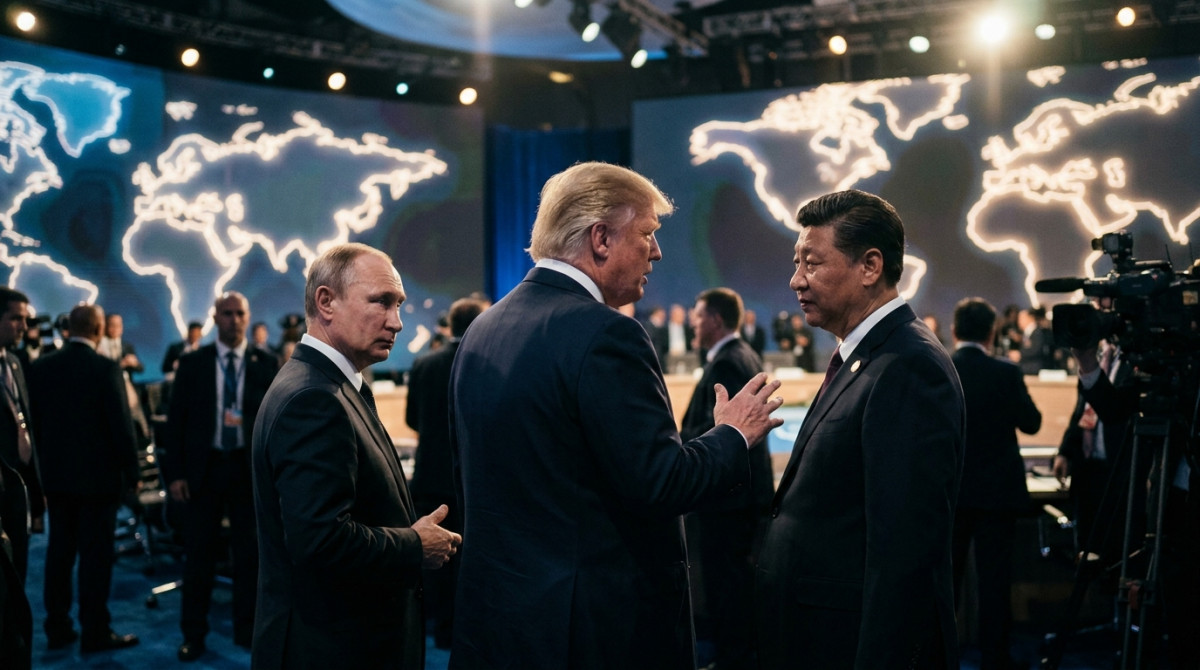
Imagine three leaders sitting together in one room.
One represents the world's most influential military alliance and a financial system that reaches almost every corner of the planet. Another leads an economic and manufacturing powerhouse whose decisions affect global supply chains, technology, trade, and investment. The third commands a country with enormous natural resources, significant military capabilities, and one of the world's largest nuclear arsenals.
Now imagine that their conversation is not simply about relations between three governments. It is about the direction of the international system itself.
That is why the meeting between U.S. President Donald Trump, Chinese President Xi Jinping, and Russian President Vladimir Putin deserves attention beyond the usual cycle of diplomatic photographs, speeches, and political reactions.
The three leaders met in Shenzhen, China, on November 19, 2026, during the Asia-Pacific Economic Cooperation summit. It was an unprecedented three-way meeting involving the current leaders of the United States, China, and Russia.
The declaration that followed spoke about nuclear risks, energy, international security, and reforming global institutions. Yet the meeting did not deliver a major breakthrough on the wars in Ukraine or Iran, nor did it announce a detailed arms-control agreement.
So why does it matter?
Because sometimes a meeting changes the way the world sees power before it changes what governments actually do.
And this meeting presented a striking image: the leaders of three countries with enormous international influence discussing the future of global affairs together, while many other nations watched from outside the room.
The photograph may matter more than the declaration
Diplomatic meetings are usually judged by their agreements. Did the leaders sign a treaty? Did they resolve a conflict? Did they announce new economic cooperation? Did they make a commitment that can be measured?
By those standards, the Shenzhen meeting produced limited results.
But international politics is not conducted only through signed documents. It is also conducted through recognition, access, symbolism, and the ability to influence what other governments consider possible.
For Vladimir Putin, sharing the stage with the American and Chinese presidents provided an opportunity to demonstrate that Russia remains an important participant in international diplomacy despite its confrontation with Western governments over Ukraine.
For Xi Jinping, hosting the meeting reinforced China's image as a country capable of bringing major powers together and providing a stage for global diplomacy.
For Trump, the gathering offered an opportunity to present himself as a leader willing to engage directly with powerful rivals rather than relying entirely on traditional diplomatic channels.
Each leader could interpret the same photograph as a diplomatic success.
But the rest of the world may interpret it differently.
The image raises an uncomfortable question: if the most powerful countries increasingly negotiate among themselves, what influence remains for countries that do not possess comparable military, economic, or technological strength?
That question may become more important than the meeting itself.
America has not disappeared, but its position is being challenged
For decades after the end of the Cold War, the United States occupied an unusually influential position in international affairs.
Its military reach, alliances, financial institutions, technology companies, universities, currency, and diplomatic network gave it influence that few countries could match.
That did not mean America could control every international event. It could not prevent every war, dictate every trade decision, or guarantee that other countries followed its preferences.
But its influence was extraordinary.
Today, the international landscape is more complicated.
China has become central to global manufacturing, trade, infrastructure, and technology. It has expanded its diplomatic reach and seeks a greater role in shaping international institutions.
Russia, despite economic constraints and its international isolation from many Western governments, retains substantial military power, nuclear capabilities, energy resources, and the ability to influence security developments across several regions.
Meanwhile, the United States remains a formidable economic, technological, military, and diplomatic power.
The important change is not that America has suddenly lost its position. It is that other countries have become increasingly capable of challenging, negotiating with, or working around American preferences.
The world is not moving from one ruler to three rulers. It is moving through a period in which power is distributed across several competing centers.
That distinction matters.
Three countries, three very different kinds of power
It is tempting to look at the three leaders and imagine that they represent a single emerging power structure.
But their countries do not possess the same strengths, and they do not necessarily want the same future.
The United States: financial reach, technology, military alliances
American influence extends far beyond its borders.
The dollar remains central to international finance. American technology companies shape digital infrastructure and software markets. U.S. universities, research institutions, and businesses attract talent and investment from around the world.
Its military alliances and overseas presence also provide strategic influence that cannot easily be replicated.
Washington's challenge is not simply maintaining its strength. It is deciding how to use that strength in a world where other major powers can resist its pressure and where traditional allies increasingly question the consistency of American foreign policy.
China: manufacturing, trade, infrastructure, and long-term ambition
China's influence is built on a different foundation.
Its manufacturing capacity, export industries, infrastructure investment, supply chains, and growing technological capabilities make it essential to the global economy.
Many countries depend on Chinese production for everything from electronics and industrial components to renewable-energy equipment.
Beijing also wants greater influence over international institutions and the rules governing trade, technology, development, and security.
The challenge for China is turning economic influence into broader international trust. Economic strength does not automatically produce political agreement, and many governments want Chinese investment without becoming strategically dependent on Beijing.
Russia: military power, nuclear weapons, energy, and strategic disruption
Russia's position is different from both America and China.
Its economy is much smaller than those of the other two countries, but its military capabilities, nuclear arsenal, energy resources, geography, and permanent seat on the United Nations Security Council give it considerable international influence.
Moscow's foreign policy is also shaped by its desire to resist what it sees as Western dominance and to preserve its status as an independent great power.
The difficulty is that military strength and diplomatic visibility do not automatically translate into economic prosperity or international acceptance.
Russia can influence the global conversation, but it cannot independently provide the economic and technological opportunities that China and the United States offer on a comparable scale.
The three countries therefore bring different resources to the table. Their cooperation may be possible in certain areas, but their competition is unlikely to disappear.
The real question: Are we entering a multipolar world?
The phrase multipolar world describes an international system in which influence is distributed among several powerful countries or groups rather than concentrated overwhelmingly in one.
This is not an entirely new idea. The world has been moving in this direction for years.
China's economic rise, India's growing influence, the European Union's regulatory and economic weight, regional powers in the Middle East, and the growing diplomatic role of countries across Asia, Africa, and Latin America have all contributed to a more complex international landscape.
The Trump-Xi-Putin meeting gives this transformation a particularly visible image.
However, a multipolar world does not necessarily mean a more peaceful world.
It could create opportunities for cooperation because no single country can easily dictate every outcome. Smaller nations might gain more choices by developing relationships with different partners.
But it could also create more competition.
Countries may face pressure to choose sides in disputes involving technology, trade, military cooperation, energy, and international security.
A world with several powerful centers can be more flexible, but it can also become harder to manage.
The biggest question is whether these powers can compete without turning every disagreement into a confrontation.
What does this mean for countries that are not in the room?
This is perhaps the most important part of the story.
The future of global politics is not only about Washington, Beijing, and Moscow.
It is also about countries that depend on international trade, affordable energy, foreign investment, security partnerships, and access to technology.
Consider a country in South Asia.
Its economy may depend on trade with China, remittances from workers in the United States and other countries, energy imports, regional infrastructure, and international development support.
A major disagreement among powerful countries can influence all of these areas.
If trade restrictions expand, businesses in smaller economies may face higher costs. If energy markets become unstable, households may pay more for transportation and electricity. If technology becomes divided into competing systems, smaller countries may struggle to access equipment, software, and digital infrastructure.
On the other hand, competition among powerful countries can create opportunities.
Governments may receive more investment offers, negotiate better infrastructure agreements, diversify trade relationships, and attract industries looking for alternative production locations.
The outcome depends on how effectively smaller countries protect their interests.
They do not have to become permanent followers of one powerful country. They can develop relationships with several partners while protecting their own economic and political independence.
But that requires long-term planning, capable institutions, and a clear understanding of national interests.
Could the three powers decide the future of the world?
There is a danger in treating the meeting as if it created a new global government.
It did not.
The United States, China, and Russia are three permanent members of the United Nations Security Council, but they are not the only countries with international influence. The United Kingdom and France are also permanent members. India, Japan, Germany, Brazil, Saudi Arabia, Turkey, and many other countries have important regional or global roles.
The European Union also remains a major economic and regulatory power.
Furthermore, the interests of the three leaders are not interchangeable.
The United States and China compete over technology, trade, security, and influence in the Asia-Pacific region. Russia and China have developed a close strategic relationship, but that does not make them identical partners. Washington has its own interests in both countries, and those interests may conflict with what Beijing or Moscow wants.
A shared declaration does not erase these differences.
The meeting should therefore be understood as a powerful diplomatic signal, not proof that the three countries have agreed to divide the world between themselves.
Still, there is a legitimate concern: when powerful governments negotiate the rules of international life, countries with less influence may find their interests overlooked.
That is why international cooperation must include more than the largest military and economic powers.
The danger of a world organized around personalities
Another important feature of this meeting was the central role of the three individual leaders.
Modern diplomacy often focuses on personal relationships between presidents and prime ministers. A warm handshake, a private conversation, or a public compliment can create the impression that difficult political problems might be solved through personal understanding.
Sometimes direct relationships help.
Leaders can communicate during crises, reduce misunderstandings, and create opportunities for negotiations that bureaucracies might struggle to initiate.
But there is a weakness in relying too heavily on personal diplomacy.
Countries are larger than their leaders.
Trade agreements, military commitments, international institutions, economic interests, and public expectations do not disappear when one president leaves office.
A relationship that looks strong today may change dramatically after an election, a leadership transition, or a national crisis.
If global stability depends too heavily on whether three individuals personally like or trust one another, it becomes fragile.
The world needs institutions and agreements that survive political personalities.
A photograph cannot guarantee that.
The nuclear question makes this meeting especially important
Among all the issues discussed in Shenzhen, nuclear security deserves particular attention.
The United States and Russia possess the world's two largest nuclear arsenals. China also has a growing nuclear capability.
A conflict involving these countries would have consequences far beyond their borders.
The leaders' declaration reaffirmed the principle that a nuclear war cannot be won and must never be fought. They also expressed support for dialogue on reducing nuclear risks.
That language is important, but it is not the same as an arms-control agreement.
A meaningful reduction in nuclear danger requires more than public statements. It needs communication channels, transparency, verification, credible commitments, and sustained negotiations.
Without these mechanisms, misunderstandings and mistrust can continue to create serious risks.
The summit may provide a starting point for future discussions. Whether it becomes something more will depend on what the governments do after the cameras are gone.
What happens to the wars and conflicts already shaping the world?
A major reason the summit attracted international attention was the hope that the leaders might make progress on existing conflicts.
But the declaration did not establish a clear path to ending Russia's war against Ukraine or resolving the conflict involving Iran.
That absence matters.
For Ukraine, discussions between powerful governments cannot replace the participation and consent of Ukrainians in decisions about their country's future.
For countries affected by conflict in the Middle East, diplomatic language will mean little without practical steps that reduce violence and protect civilians.
For the wider international community, the question is whether the three powers can use their influence to reduce tensions or whether they will simply use diplomacy to strengthen their own positions.
The difference between those two possibilities is enormous.
A world in which major powers cooperate to prevent war could become safer.
A world in which they cooperate mainly to protect their own privileges could become more unequal and unpredictable.
The future may belong to countries that know how to balance relationships
The next chapter of international politics may not be determined only by the three largest powers.
It may also be shaped by countries that understand how to navigate between them.
India, for example, maintains important relationships with the United States and Russia while competing with China in several areas. European countries must balance their security dependence on the United States with their economic interests and their desire for strategic independence. Countries in Southeast Asia often seek investment and trade with China while maintaining security and diplomatic relationships with other powers.
This balancing act will become increasingly important.
Smaller economies will also need to think beyond traditional foreign policy.
They will need to invest in education, digital infrastructure, energy security, domestic industries, research, and resilient supply chains.
A country that has strong institutions and a productive economy has more choices than one that depends on a single source of investment or assistance.
The greatest protection against becoming someone else's bargaining chip may be the ability to stand on your own feet.
A different world is possible, but it is not guaranteed
It is easy to look at three powerful leaders meeting together and imagine that a completely new world order is about to emerge.
But history rarely changes through one meeting alone.
The Cold War did not end because of one handshake. Globalization did not develop through one trade agreement. China's rise was not the result of one diplomatic event.
Major changes happen through years of economic development, technological progress, political decisions, military competition, institutional change, and social transformation.
The Shenzhen meeting may become an important symbol of this period, but its actual significance will be determined by what follows.
Will nuclear-risk discussions continue?
Will the leaders make meaningful progress on international conflicts?
Will their countries cooperate on climate, trade, technology, and global economic stability?
Will other countries be given a meaningful voice in decisions that affect them?
Or will this remain a historic photograph accompanied by a declaration that changes very little?
Those are the questions worth watching.
The world belongs to more than its most powerful leaders
Perhaps the most important lesson from this meeting is not that three countries now control the world.
It is that the balance of global power is changing, and every country needs to understand what that means.
America remains powerful. China continues to expand its influence. Russia retains strategic capabilities that make it impossible to ignore. Other countries and regional organizations also have roles that cannot simply be erased.
The future will not necessarily belong to one country, or even to three.
It may belong to a world where influence is distributed, alliances are more flexible, and governments must negotiate with a wider range of powerful actors.
That future could bring more cooperation, more competition, or both.
But there is one principle that should not be forgotten: ordinary people should not become invisible in conversations about global power.
The success of international diplomacy should not be measured only by how confidently leaders stand together in front of cameras. It should also be measured by whether families feel safer, whether economies create opportunities, whether countries retain their independence, whether conflicts become less destructive, and whether future generations inherit a more stable world.
Three leaders can meet in one room and discuss the future of the planet.
But the planet belongs to billions of people who were not invited to that meeting.
And their future matters just as much.
Frequently Asked Questions
What's Your Reaction?
 Like
0
 Dislike
0
 Love
0
 Funny
0
 Wow
0
 Sad
0
 Angry
0










Comments (0)