

The Subscription Trap: How Monthly Payments Quietly Changed the Way We Own Almost Everything
Subscriptions have transformed how people access entertainment, software, transportation, shopping, and everyday services. Although recurring payments offer convenience and flexibility, they can also create long-term expenses, dependence on providers, and a gradual shift away from ownership. This article explores the hidden economics behind the subscription economy and what consumers may be giving up in exchange for convenience.

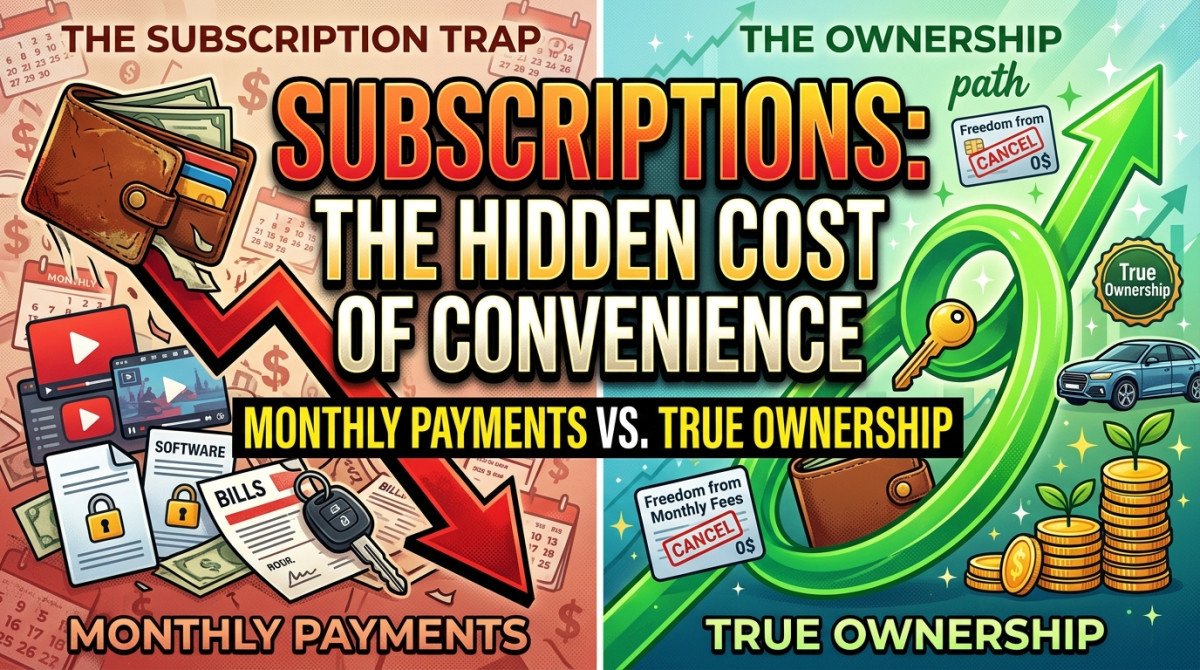
There was a time when buying something meant it belonged to you.
You bought a music album, and you could listen to it whenever you wanted. You purchased software, installed it on your computer, and continued using it. You bought a movie, a book, a game, or a physical product, and the transaction generally ended when you paid for it.
Today, things work differently.
You can pay every month to listen to music, watch films, store photographs, edit documents, use design software, access fitness programs, unlock additional features in a car, or receive products at your doorstep.
Even products that once required a single purchase are increasingly being offered through recurring-payment models.
At first, it seems like a better arrangement. Instead of paying a large amount upfront, you pay a smaller amount regularly. You get access to services without worrying about maintenance, upgrades, or purchasing the latest version.
But something interesting has happened.
We have become comfortable paying repeatedly for things that previous generations expected to own.
The change is so gradual that many people barely notice it. A few dollars for music, another payment for video streaming, a cloud storage plan, a productivity application, a fitness membership, a shopping membership, and perhaps a premium service for a device already sitting in the house.
Individually, these payments may appear insignificant.
Together, they represent a different relationship between people and the things they use.
This is the subscription economy: a business model built around recurring payments rather than one-time transactions.
And the bigger question is not whether subscriptions are good or bad.
It is whether convenience is quietly changing what ownership means.
1. When buying something stopped being the end of the transaction
Traditional purchasing was relatively straightforward.
A customer wanted something, paid for it, and received ownership or a defined right to use it. The seller earned revenue, and the customer generally decided what happened next within the limits of the product and applicable law.
Subscription businesses operate differently.
The relationship continues after the initial purchase.
Instead of earning money once, a company receives recurring payments as long as the customer remains subscribed. This creates a continuous commercial relationship.
For businesses, that can be attractive because recurring revenue makes future income more predictable, although cancellations, customer acquisition costs, service expenses, and changing demand still matter.
For consumers, subscriptions can offer several genuine advantages:
-
Lower upfront costs.
-
Access to services that are expensive to purchase outright.
-
Regular software updates.
-
Convenience and automatic delivery.
-
The ability to stop using a service without reselling a product.
-
Access to large libraries of content or tools.
Consider a professional who needs advanced design software for a short project. Paying for a month may make more sense than purchasing an expensive permanent license.
The problem begins when temporary access becomes a permanent household expense.
A customer may originally subscribe for one specific purpose, but the payment continues long after that purpose disappears.
The purchase is no longer a single decision. It becomes a decision that repeats automatically.
2. The small-payment illusion
One of the most effective features of subscription pricing is that it makes the initial cost feel manageable.
A service advertised at $9.99 per month sounds inexpensive compared with an annual payment of $119.88.
The monthly price is easier to fit into a budget, and customers may focus more on the immediate affordability than on the total cost.
But recurring payments accumulate.
Imagine someone maintaining these hypothetical subscriptions:
| Service | Monthly cost |
|---|---|
| Video streaming | $15 |
| Music streaming | $12 |
| Cloud storage | $10 |
| Productivity software | $20 |
| Fitness application | $15 |
| Shopping membership | $10 |
| Gaming subscription | $17 |
| Total | $99 |
<text color="secondary" size="xs">Illustrative prices only, not current advertised prices for particular services.</text>
That is $99 every month, or $1,188 over a year.
Over five years, the same unchanged monthly spending would reach $5,940.
This does not automatically mean the person wasted that money. They may have received thousands of hours of entertainment, valuable professional tools, convenient shopping, and useful services.
The important point is that the total cost becomes harder to recognize when each individual transaction is small.
A one-time purchase forces us to confront the price immediately.
A subscription spreads that decision across months and years.
That psychological difference can make recurring expenses easier to overlook.
3. We are paying for access to things we once owned
Perhaps the most significant change is happening in digital products.
Think about music.
Previous generations often purchased records, CDs, or downloaded music files. They could keep physical copies, lend them, resell them, or play them on compatible equipment.
Streaming services offer something different: access to an enormous library while the subscription remains active.
The same transformation has happened in other industries.
Software: Many applications that were once sold with perpetual licenses now operate through monthly or annual plans.
Movies and television: Instead of purchasing individual films, viewers subscribe to platforms whose libraries can change over time.
Video games: Some gaming services provide access to rotating collections of titles rather than permanent ownership of every game.
Cloud storage: People pay to keep photographs, documents, and backups stored beyond free account limits.
Digital publishing: Some publications place their archives and premium reporting behind recurring memberships.
These models are not necessarily inferior. Streaming offers a level of convenience and variety that buying individual albums or films could not easily reproduce.
However, access and ownership are not identical.
When a subscription ends, access may disappear. When a company removes a title, changes its terms, discontinues a service, or closes its platform, customers may lose access to things they previously used regularly.
A digital library can feel personal without necessarily being owned.
That distinction is becoming increasingly important.
4. The subscription model is moving beyond the internet
Subscriptions were once strongly associated with newspapers, magazines, gyms, and entertainment.
Now, the model is spreading into physical products and services.
Some examples include:
-
Clothing and personal-care deliveries.
-
Meal kits and grocery deliveries.
-
Pet food and household essentials.
-
Vehicle features and connected services.
-
Smart-home applications.
-
Fitness equipment memberships.
-
Coffee and specialty food deliveries.
-
Premium maintenance and support packages.
Even some car manufacturers have experimented with subscriptions for particular vehicle features.
The idea is simple: instead of selling every feature permanently, a company may offer continued access through an ongoing payment.
For customers, this can sometimes provide flexibility. For businesses, it can create another source of revenue after the original product sale.
But it also raises an uncomfortable question.
If a person has already purchased a physical product, why should certain functions continue to require payments?
There may be legitimate costs associated with cloud services, connectivity, maintenance, and ongoing infrastructure. Those services are different from unlocking functionality already installed in a product.
Consumers should be able to understand exactly what they are paying for.
The difference between paying for a continuing service and paying repeatedly to use something already purchased matters.
5. The business incentive: Why companies love recurring revenue
To understand why subscriptions are spreading, it helps to look at the business model.
Imagine two companies selling the same digital product.
Company A sells it for $100 once.
Company B charges $10 every month.
Company A receives its revenue immediately, but it must continue finding new customers to generate additional sales.
Company B can build a continuing relationship with customers. If they remain subscribed, the business receives additional payments over time.
That creates several potential advantages:
Predictable revenue: Recurring payments can make financial planning easier, although actual revenue still depends on customer retention and cancellations.
Customer relationships: Companies can communicate with subscribers, introduce features, and develop additional services.
Continuous product development: Regular income can help fund updates, customer support, infrastructure, and improvements.
Lower initial barriers: A lower entry price can attract customers who would not purchase a more expensive product outright.
Long-term customer value: A subscriber who stays for several years may generate substantially more revenue than someone who makes a single purchase.
A 2025 paper published in the American Economic Review examined subscription purchasing using payment-card data. Its authors studied how consumer inattention and switching costs can affect cancellations. Their models estimated that cancellation frictions could roughly double seller revenue on average, holding initial subscribers fixed.
That is an important finding because it highlights a distinction between customers who actively value a service and customers who continue paying partly because leaving requires attention or effort.
The research does not mean every subscription business depends on customer forgetfulness. It shows why cancellation design and consumer inertia matter economically.
6. The hidden cost is not always money
A subscription can cost more than its advertised monthly price.
It can also cost attention, time, flexibility, and control.
Consider someone who signs up for a free trial.
They intend to test a service for a few days. The trial requires payment details, and automatic renewal begins when the trial period ends.
The customer gets busy, forgets the date, and the first payment arrives.
This may happen once, or it may happen across several services.
Then comes the cancellation process.
Some services make cancellation straightforward. Others require several screens, additional confirmation steps, a telephone call, or contact with customer support.
The longer a customer postpones the task, the more payments may accumulate.
Research published in the American Economic Review provides evidence that cancellation friction can be financially significant for subscription sellers. The Federal Trade Commission has also documented concerns about consumers being charged for services they no longer want and facing obstacles when trying to cancel.
The problem is not automatic renewal itself. Automatic renewal can be convenient.
The problem is when the process of continuing is almost effortless but the process of leaving is unnecessarily difficult.
A fair subscription should make the customer's choice clear in both directions.
7. Subscription fatigue: When every company wants a monthly payment
There is a point at which convenience begins to feel like administration.
One subscription is easy to manage.
Five may still be manageable.
But when entertainment, shopping, software, fitness, education, storage, transport, and household services all require separate accounts and recurring payments, consumers must keep track of an increasingly complicated collection of financial relationships.
This is commonly described as subscription fatigue.
A 2025 global consumer survey by Chargebee found that 44% of respondents said subscriptions took a moderate or significant portion of their budget. The same survey reported that 90% had noticed at least one subscription price increase during the previous year, while only 58% considered the increase justified.
These findings come from a survey rather than a complete measurement of every household's spending, but they illustrate why consumers are becoming more conscious of recurring charges.
The fatigue is not simply about the amount of money.
It is also about having to remember:
-
Which services are active.
-
Which payment method each service uses.
-
When free trials expire.
-
Which plans have increased in price.
-
Whether a service is still being used.
-
How to cancel an unwanted membership.
A person may spend more time managing subscriptions than enjoying some of the services themselves.
That is when convenience starts creating its own inconvenience.
8. The danger of building a life around services we do not control
Ownership offers something that subscriptions cannot always provide: a degree of independence.
If you own a physical book, you can generally read it without asking the publisher for continued permission.
If you own a downloaded file without restrictive licensing, you may be able to store and use it independently of the original seller.
If you purchase a physical product, you may be able to repair it, modify it, sell it, or pass it to another person, subject to applicable restrictions.
Subscription services introduce another party into the relationship.
The company controls the platform, access conditions, pricing, availability, and sometimes the continued existence of the service.
That creates several potential risks.
Price changes
A subscription that was affordable when first purchased may become expensive after several price increases.
Service discontinuation
A company may shut down a service, remove features, or change its business model.
Account restrictions
Access can be interrupted because of billing problems, account suspensions, technical failures, or changes to eligibility.
Reduced flexibility
Customers may become dependent on a particular platform because their files, habits, purchases, or workflows are connected to it.
Loss of access
A person may lose access to a digital collection or premium feature when the subscription ends.
None of these risks means consumers should avoid subscriptions altogether.
It means access should not automatically be mistaken for ownership.
9. Are subscriptions actually cheaper than buying?
Sometimes, yes.
Sometimes, absolutely not.
The answer depends on how often a service is used, how long it is needed, whether alternatives exist, and what the subscription includes.
Consider three situations.
Situation A: Professional software
A freelancer needs an advanced editing tool for one short project. A monthly subscription may be more affordable than purchasing an expensive permanent license.
Situation B: Entertainment
A household watches several films every week. A streaming subscription may provide better value than purchasing every film individually.
Situation C: A rarely used application
Someone subscribes to a premium productivity application but opens it only once every two months. A recurring payment may make little financial sense.
The important question is not whether a subscription is cheap.
It is whether the value received is worth the total amount paid.
A useful comparison is:
| Question | Why it matters |
|---|---|
| How frequently do I use it? | Measures actual value |
| What is the annual cost? | Reveals the full commitment |
| Is there a one-time purchase alternative? | Helps compare ownership and access |
| Can I cancel easily? | Measures flexibility |
| What happens when I cancel? | Reveals what access or data may be lost |
| Can I use a free alternative? | Prevents unnecessary spending |
A subscription should earn its place in someone's budget rather than survive simply because it renews automatically.
10. The future: Will we subscribe to almost everything?
The subscription model is unlikely to disappear.
Businesses have strong incentives to offer recurring services, and many consumers genuinely prefer access over ownership.
The future may bring even more subscription-based services involving artificial intelligence, connected vehicles, smart homes, personalized education, digital health tools, and automated household services.
Artificial intelligence is particularly interesting.
Some AI products are already offered through monthly plans that provide different usage limits, capabilities, storage, or access to advanced models.
As these services become integrated into daily work, education, and personal organization, subscriptions may become even more common.
However, consumers may also become more selective.
They may demand the ability to pause plans, change tiers, pay according to usage, or combine services instead of maintaining multiple separate memberships.
The 2025 Chargebee survey found that 78% of respondents considered the ability to pause, swap, or meter subscriptions very or extremely important when choosing a subscription. This suggests that flexibility is not simply a bonus; it can influence purchasing decisions.
Businesses that understand this may compete not only through lower prices but also through clearer terms and greater customer control.
The subscription economy may continue growing, but that does not mean consumers will accept every recurring-payment model.
11. How to escape the subscription trap without giving up convenience
The goal should not be to cancel everything.
Some subscriptions provide excellent value and genuinely make everyday life easier.
The goal is to become more intentional about what deserves a recurring payment.
Here are seven practical steps.
1. Make a complete subscription list
Review bank statements, credit-card transactions, app-store purchases, and email receipts. Write down every active recurring payment.
Do not rely entirely on memory.
2. Calculate the annual cost
Multiply the monthly price by 12. A service costing $8 per month is $96 per year, not simply eight dollars.
3. Separate essential services from optional ones
Cloud backups, professional tools, and communication services may serve important purposes. Entertainment add-ons and rarely used applications may be easier to remove.
The distinction depends on individual needs.
4. Cancel subscriptions you no longer use
If you have not opened a service for several months, ask whether you still need it.
If you might need it again, check whether it can be restarted later without losing important data.
5. Review free trials before signing up
Know when the trial ends, what the renewal price will be, and how to cancel.
Set a reminder rather than assuming you will remember.
6. Compare monthly and annual plans carefully
Annual plans sometimes offer lower effective monthly prices, but only when you are confident that you will use the service for the entire year.
Paying upfront for something you stop using after two months is not a saving.
7. Keep control of important personal data
Download important documents, maintain independent backups, and understand what happens to your files when a cloud or software subscription ends.
Never assume that canceling a service leaves your information available forever.
The simplest rule is this: keep paying for services that provide continuing value, not services that continue charging because you forgot about them.
12. Perhaps the real luxury is having a choice
Modern life has made access remarkably easy.
With a few taps, people can listen to almost any song, watch thousands of films, use advanced software, store enormous collections of photographs, and access services that would once have required expensive purchases.
That is progress.
But convenience should not come at the cost of losing the ability to choose.
There is a difference between wanting a service and being financially committed to it indefinitely. There is a difference between renting access because it is practical and being unable to use something without another monthly payment.
We should not romanticize the past. Ownership also involved maintenance, repairs, storage, upfront costs, and limitations. Subscriptions can solve real problems and make valuable products accessible to more people.
But we should also question a business culture in which almost every interaction becomes an opportunity for another recurring charge.
Perhaps the future of consumer freedom will not be about owning absolutely everything.
It will be about understanding what we own, what we rent, what we access, and what we are agreeing to pay for over time.
Because the most expensive subscription is not always the one with the highest monthly price.
Sometimes it is the one we never stop to question.
Frequently Asked Questions
What's Your Reaction?
 Like
0
 Dislike
0
 Love
0
 Funny
0
 Wow
0
 Sad
0
 Angry
0












Comments (0)