

Why US Flights Keep Falling Into Chaos: The Hidden Weakness Behind FAA and Airline System Failures
From FAA network disruptions to Delta's latest weight-and-balance system failure, America's aviation problems reveal a deeper weakness: a highly connected transportation network that can struggle when critical technology fails. This analysis explains how one technical glitch can delay thousands of travelers, why recovery takes so long, and what airlines and regulators must change to make air travel more resilient.

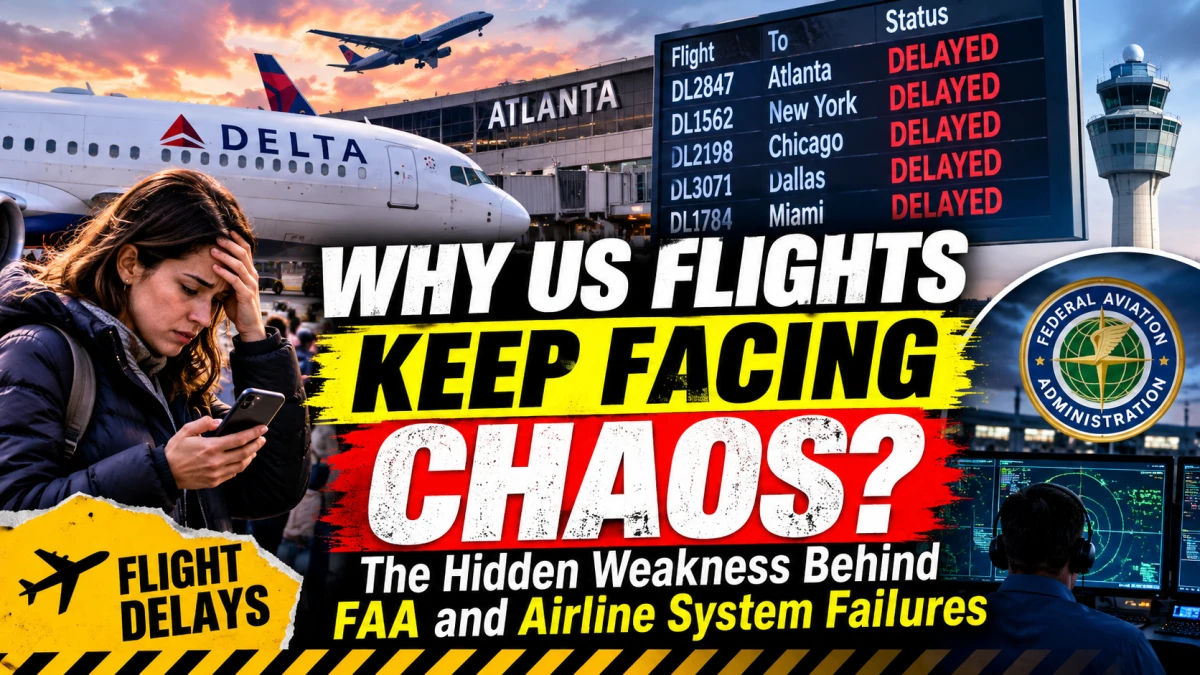
America's aviation system is one of the most sophisticated transportation networks in the world. Every day, thousands of aircraft move through an intricate web of airports, air traffic controllers, airline operations centers, pilots, maintenance teams and digital systems.
For many travelers, understanding the importance of international travel goes beyond choosing a destination. It also means understanding the systems that make global journeys possible.
Yet, every time a major technical problem appears, the consequences can be enormous.
On November 22, 2026, Delta Air Lines faced widespread flight delays after an issue with its automated aircraft weight-and-balance system disrupted operations at its Atlanta hub. The Federal Aviation Administration (FAA) temporarily stopped Atlanta-bound Delta flights before moving to a ground-delay program. Delta said its teams were using manual procedures to dispatch flights safely while working to restore automation.
The incident came amid a series of recent aviation disruptions, including a separate FAA network malfunction and a United Airlines system outage.
The question is no longer simply why flights are delayed.
The more important question is this: Why can a modern aviation system become so vulnerable when one piece of technology stops working?
One technical failure, thousands of delayed passengers
The latest Delta disruption illustrates how a problem inside one airline can spread far beyond the airport where it begins.
Atlanta's Hartsfield-Jackson International Airport is a major hub for Delta. Flights arriving there connect passengers to destinations throughout the United States and around the world.
When Delta's weight-and-balance automation system failed, the airline could not rely on its normal digital process for preparing departing aircraft.
Weight-and-balance calculations are not optional paperwork. They help determine whether an aircraft is loaded within safe limits and whether its weight is distributed correctly for flight.
If the automated process is unavailable, staff must use approved alternative procedures. These procedures can be safe, but they are generally slower and require more human effort.
The result is a bottleneck.
A flight that cannot be prepared on time may miss its departure slot. Its aircraft may arrive late for the next journey. The crew may reach its duty-time limit. Passengers may miss connecting flights.
Soon, a technical problem that began in one operational system can affect flights in several cities.
This is the hidden nature of modern aviation disruption: the failure may be local, but the consequences are connected.
Is the FAA responsible for every flight delay?
No. This is one of the biggest misunderstandings about American air travel.
The FAA is responsible for managing the national airspace system, regulating aviation safety and coordinating air traffic.
Airlines, however, operate their own systems for flight planning, passenger check-in, baggage handling, aircraft loading, crew scheduling, maintenance and other essential activities.
These systems interact with one another, but they are not all operated by the FAA.
In the November 22 Delta incident, the FAA said the delays were not related to its air traffic systems. The problem originated with Delta's weight-and-balance automation.
The FAA nevertheless had to manage the consequences.
When an airline cannot operate normally at a major airport, the FAA may issue a ground stop or ground delay to prevent too many aircraft from arriving at a congested airport.
A ground stop means affected flights are temporarily prevented from departing for a destination. A ground delay program allows flights to depart with assigned delays so that traffic can reach the destination at a manageable rate.
These measures are not necessarily evidence that the FAA's technology has failed. They can be tools used to prevent a local operational problem from becoming a more dangerous air traffic situation.
The distinction matters: an airline can cause the disruption, while the FAA manages the traffic consequences.
Why does one airport affect the entire country?
The answer is the hub-and-spoke model.
Airlines organize their networks around major connecting airports. Instead of operating every route directly between two cities, they bring passengers together at hubs and send them onward to other destinations.
This model makes air travel more efficient and allows airlines to serve many routes with fewer direct flights.
But it also creates concentration risk.
When a major hub experiences a disruption, aircraft and passengers become trapped in the wrong places. A plane scheduled to fly from Atlanta to New York may be delayed in Atlanta. That same aircraft might have been scheduled to fly from New York to another city later in the day.
Travelers exploring destinations around the world should also consider how airport connections and transportation networks can influence their overall journey.
The disruption travels with the aircraft.
Crews are also part of the equation. Pilots and flight attendants have legally defined duty limits. A delay can cause a crew to become unavailable for its next flight, even after the original technical issue has been resolved.
Passengers experience the same chain reaction through missed connections, rebooking queues and limited replacement seats.
This is why restoring a computer system does not instantly restore an airline's schedule.
Why can't airlines simply switch to a backup system?
This is where the real technology question begins.
Airlines use complex software that must exchange accurate information about aircraft, passengers, cargo, fuel, crew, weather and airport operations.
A backup system is not useful simply because it exists. It must be capable of taking over the same work, using reliable data, and operating safely under pressure.
Some systems have manual fallback procedures. Delta said its teams were using manual workarounds during the November 22 disruption.
But manual operations have limits.
A process that software can complete quickly may require multiple employees to verify information, enter calculations, check records and communicate with other departments.
The challenge is not just having a backup. It is having a backup that can handle the volume of a major airline.
A resilient system should be designed so that one failure does not immediately stop an entire operation. That may require independent backup infrastructure, tested recovery procedures, reliable data replication and the ability to operate essential functions separately from nonessential services.
The aviation industry needs to treat these capabilities as part of safety and operational readiness, not merely as an information-technology expense.
The deeper problem: efficiency has become a vulnerability
Modern airlines are built around efficiency.
Aircraft utilization is optimized. Crews are scheduled tightly. Passenger connections are carefully coordinated. Digital systems reduce paperwork and speed up operations.
These improvements help airlines control costs and serve more passengers.
But efficiency and resilience are not always the same thing.
A system with very little spare capacity can perform exceptionally well during normal conditions and struggle when something unexpected happens.
A flight schedule with minimal recovery time may be profitable on a good day. During a system outage, it can become extremely difficult to recover.
The same principle applies to technology.
Technology continues to transform industries, from transportation and communication to space exploration, where long-distance missions depend on reliable systems operating for decades.
If several critical processes depend on one central platform, that platform becomes a potential single point of failure. If the backup depends on the same network, the same data source or the same infrastructure, it may fail at the same time.
The industry should ask whether it has optimized too heavily for normal operations and not enough for disruption.
What actually needs to change?
The solution is not to abandon automation. Aviation depends on technology, and modern air traffic could not operate at today's scale without it.
The solution is to build systems that fail more gracefully.
1. Independent backup systems
Critical airline and FAA systems should have backup capabilities that are genuinely independent of the primary system.
A backup that relies on the same vulnerable network or infrastructure may offer little protection during a major outage.
2. Regular recovery testing
Airlines and aviation authorities should regularly test what happens when essential systems become unavailable.
It is not enough to have a recovery plan written in a document. Staff must know how to use it, and the process must be tested under realistic operating conditions.
3. Better manual fallback capacity
Manual procedures should be practical, well documented and supported by enough trained personnel.
The industry should identify which operations can continue safely during a digital outage and how much traffic can realistically be handled without automation.
4. More transparent communication
Passengers often receive vague explanations such as "operational issues" or "technical difficulties."
Airlines should provide clear information about whether the problem is related to the airline, the airport, weather or air traffic control.
Better information will not eliminate delays, but it can reduce confusion and help passengers make decisions earlier.
5. More realistic scheduling
Airlines need enough operational flexibility to recover from disruptions.
That does not mean adding unnecessary delays to every flight. It means recognizing that a tightly connected network requires recovery time, spare aircraft capacity and contingency planning.
Can artificial intelligence solve the problem?
Artificial intelligence may help airlines predict delays, identify emerging bottlenecks, optimize aircraft and crew assignments, and detect unusual system behavior.
But AI is not a substitute for reliable infrastructure.
If an airline's critical data is unavailable, inaccurate or corrupted, an intelligent system may still be unable to make safe decisions.
In aviation, the goal should not be to automate everything as quickly as possible. It should be to use automation in a way that improves reliability, safety and recovery.
The best technology is not the one that never encounters a problem.
It is the one that allows the operation to continue safely when a problem occurs.
The real lesson from America's recurring flight chaos
The recent disruptions do not all have the same cause. A Delta weight-and-balance system failure is different from an FAA network malfunction, a weather disruption or an airline baggage-system outage.
Treating every incident as the same failure would be misleading.
But the incidents reveal a shared challenge: aviation is an interconnected system, and its reliability depends on many organizations and technologies working together.
The FAA cannot independently prevent every airline software failure. Airlines cannot control every air traffic restriction. Airports cannot solve every crew or aircraft shortage.
What they can do is design their systems and procedures to contain failures rather than allowing them to spread.
For passengers, the expectation is simple: buy a ticket, arrive at the airport and reach the destination safely and on time.
For the aviation industry, delivering that expectation requires something more complicated than faster computers.
It requires resilience.
Because the real test of a modern aviation system is not how efficiently it operates when everything works.
It is how safely and quickly it recovers when something doesn't.
Frequently Asked Questions
What's Your Reaction?
 Like
0
 Dislike
0
 Love
0
 Funny
0
 Wow
0
 Sad
0
 Angry
0
















Comments (0)