

The Museum of Things We Never Display: How Ordinary Household Objects Carry the History of Generations
Not every piece of history belongs inside a museum. Some of the most meaningful records of human culture are hidden in ordinary homes: an old cooking pot, a handwritten letter, a repaired piece of clothing, or a wooden chair passed down through generations. Discover how everyday belongings preserve family memories, cultural identities, and stories that might otherwise disappear.

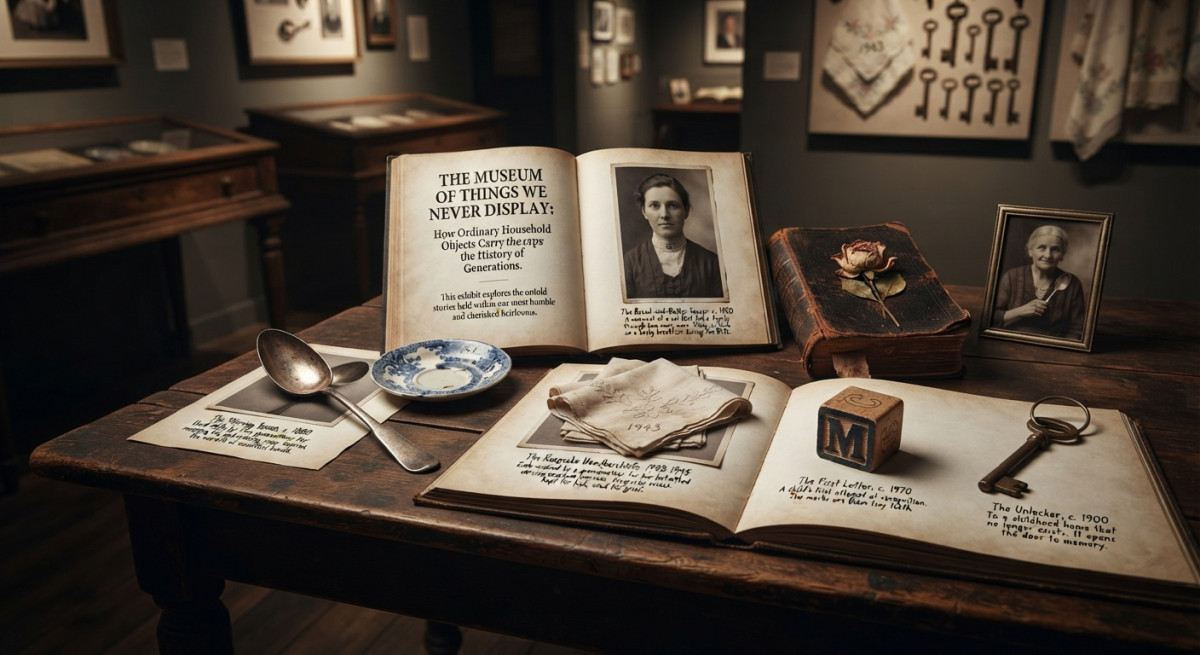
Imagine opening an old cupboard in your grandparents' home.
Inside, you might find a metal cooking pot with a darkened bottom, a collection of handwritten letters tied together with a piece of thread, a small wooden box, an old photograph, or a piece of clothing that nobody has worn for decades.
To someone unfamiliar with the family, these things might look ordinary, outdated, or even useless.
But ask the person who has kept them for forty years, and you may discover an entirely different story.
The cooking pot might have been used during a wedding celebration. The letters might contain the only remaining words from a relative who moved overseas. The wooden box might have traveled through several generations. That old photograph might preserve the face of someone whose name is still spoken at family gatherings.
These objects are not simply possessions. They are pieces of personal history.
We often associate cultural heritage with impressive buildings, archaeological discoveries, historic monuments, traditional festivals, and valuable museum collections. Yet some of the most intimate expressions of culture are found in places that rarely receive public attention.
They exist in kitchens, bedrooms, storage rooms, family gardens, workshops, and drawers that nobody opens very often.
Perhaps every family has a museum of its own. The difference is that most families never give it a name.
1. History Does Not Always Look Historical
When people think about history, they often imagine something old, important, and officially documented.
They picture ancient sculptures, royal clothing, historical manuscripts, monuments, and objects protected behind glass.
However, history is not limited to objects that have been recognized by historians or collected by institutions.
A simple household item can reveal how people lived, worked, ate, communicated, celebrated, and adapted to changing circumstances.
Consider an ordinary cooking utensil.
Its design may reflect the ingredients commonly used in a particular region. Its material may reveal which resources were available. The way it was used may demonstrate traditional cooking methods that are no longer common.
A handwoven basket can tell a story about local materials, agricultural practices, craftsmanship, and the knowledge of the person who made it.
An old sewing machine can represent a family's relationship with clothing, repair, creativity, and household economics.
The object itself might have little financial value, but its cultural and historical significance can be considerable.
This is one reason everyday objects deserve more attention. They preserve details of life that formal historical records do not always capture.
2. The Kitchen Is One of the Most Powerful Archives of Culture
A kitchen is often more than a place where meals are prepared.
It is where recipes are repeated, techniques are taught, ingredients are introduced, and family traditions are maintained.
A particular pot might be used only for preparing a special festival meal. A wooden spoon may have belonged to a grandmother. A stone grinder may have been used for generations before modern kitchen appliances became common.
These objects carry knowledge through repeated use.
Food traditions are particularly interesting because they connect physical objects with memory.
A recipe written on an old piece of paper may contain no exact measurements. Instead, it might say:
-
Add flour until the mixture feels right.
-
Cook until the smell changes.
-
Use the same amount your mother used.
-
Add spices according to taste.
To someone unfamiliar with the method, these instructions may seem incomplete. But within the family, they can represent years of experience.
The person preparing the food understands what the words mean because they learned by watching, tasting, and practicing.
In this way, a recipe can preserve much more than ingredients. It can preserve a method of thinking and doing.
Across different cultures, kitchens contain objects that connect generations. Clay cooking vessels, cast-iron pans, traditional knives, wooden boards, grinding stones, fermentation jars, and serving dishes all reflect different relationships between people and food.
When these objects disappear without their stories being recorded, part of that everyday knowledge can disappear with them.
3. Old Clothing Can Tell Stories That Photographs Cannot
A piece of clothing can hold an extraordinary amount of cultural information.
Traditional garments often reflect climate, geography, available materials, craftsmanship, social customs, and regional identity.
But clothing also carries personal stories.
A wedding dress may represent an important family celebration. A handmade shawl might have been woven by someone who is no longer alive. A child's first traditional outfit might have been carefully stored for decades.
Even ordinary clothing can have meaning.
Consider a jacket that someone wore while working abroad, a scarf carried during a difficult journey, or a handmade garment that was repaired several times instead of being replaced.
Each repair may represent a decision to preserve something that mattered.
In many communities, clothing is also connected with ceremonies, religious occasions, festivals, and important stages of life.
The techniques used to weave, embroider, dye, or decorate fabric can reflect knowledge passed between generations.
When a traditional garment is preserved without information about its origin, some of its story becomes difficult to recover.
Who made it? What materials were used? Was it worn every day or only on special occasions? What did its patterns mean to the person who created it?
These questions reveal that preserving an object is not always the same as preserving its history.
Sometimes, the story needs to be protected just as carefully as the object itself.
4. Handwritten Letters Are Personal Records of Another World
Before instant messages, video calls, and social media, letters were an important way for people to remain connected across distance.
A handwritten letter could take days or weeks to reach its destination. People often spent time choosing their words because they knew the recipient might read the message many times.
Today, old letters can offer a glimpse into everyday life that is difficult to recreate through official historical documents.
They might describe:
-
Someone leaving their hometown to find work.
-
A family waiting for news from a relative overseas.
-
A student describing life in another city.
-
A parent sending advice to a child.
-
Friends remembering a shared experience.
-
A couple maintaining a relationship across distance.
These are not necessarily major historical events. They are ordinary human experiences.
Yet they can help future generations understand how people communicated, what they worried about, what they hoped for, and how relationships were maintained.
A letter can also reveal changes in language, handwriting, expressions, and communication habits.
Unlike a photograph, which captures a particular visual moment, a letter can preserve someone's way of expressing thoughts.
It allows future readers to encounter not only what happened but also how someone felt about it.
5. The Objects People Repair Often Have the Most Interesting Stories
There is something revealing about an object that has been repaired repeatedly.
A broken chair with a replacement leg, a cooking pot with a patched handle, a suitcase with an old repair, or a wooden table with visible marks of use can reveal how people valued possessions.
In many households, replacing something was not always easy or affordable. Repairing an item was often a practical necessity.
But over time, repeated repairs could create a deeper relationship between a person and an object.
A chair might have been repaired by a father, used by several children, and eventually kept by a grandchild.
The repaired parts become evidence of different moments in the object's life.
Modern consumer culture often encourages people to replace damaged items quickly. That does not mean older generations never discarded things, or that every old object should be preserved. But the contrast between repairing and replacing can reveal changing attitudes toward materials, money, craftsmanship, and consumption.
An object that has survived decades may tell us something about the person who refused to throw it away.
Sometimes its imperfections are the most meaningful parts.
6. A Family Photograph Is More Than a Picture
A photograph can capture a moment, but the people who remember that moment give it meaning.
An old family photograph might show a group standing outside a house, relatives gathered around a table, children wearing festival clothing, or a family member preparing to leave for another country.
Without explanation, future viewers may not know who the people are or why the photograph was taken.
They might not recognize the building, understand the occasion, or know what happened before and after the picture.
This is why photographs benefit from context.
A short note containing names, approximate dates, locations, and relationships can transform an unidentified image into a useful family record.
Imagine finding a photograph of a crowded family gathering from 1965.
With no explanation, it is simply an old image.
But if someone records that the gathering celebrated a wedding, identifies the people, and explains that several relatives had traveled from distant villages, the photograph becomes a window into family life.
It may also reveal changes in architecture, fashion, transportation, social customs, and community relationships.
Photographs are powerful, but the stories attached to them make them even more valuable.
7. Every Object Has a Geography
The history of an object is often connected to a particular place.
A wooden carving may reflect the trees and craftsmanship of a region. A ceramic bowl may come from a local pottery tradition. A woven textile may represent the materials, patterns, and techniques associated with a community.
Even an ordinary household tool can reveal something about geography.
Consider the differences between objects used in:
-
Mountain communities, where materials and tools may reflect difficult terrain and colder climates.
-
Coastal communities, where fishing equipment and household items may reflect relationships with the sea.
-
Desert communities, where water storage and heat-resistant materials can influence everyday objects.
-
Agricultural communities, where tools and containers may reflect local crops and farming practices.
The relationship between place and objects is not always obvious.
People move, trade, migrate, and exchange ideas. An object found in one country may have been manufactured in another, purchased during international travel, or inherited from a relative who lived overseas.
That movement is part of its history.
An old suitcase in a family home, for example, might represent migration. A foreign coin kept in a drawer might represent travel. A traditional cooking tool carried across continents might represent the effort to preserve familiar food in a new country.
Objects can therefore tell stories about both where people came from and where life eventually took them.
8. Migration Creates New Museums Inside Families
When people move to another country, they often carry a small selection of belongings.
Some items are practical: clothing, documents, tools, or cooking equipment.
Others are emotional.
A photograph, a small religious or ceremonial object, a traditional garment, or a familiar household item can help someone maintain a connection with the place they left behind.
For families living across borders, these objects can become especially meaningful.
A child growing up in a different country may encounter a traditional item without fully understanding its significance.
Perhaps it is a cooking pot used during a particular festival. Perhaps it is an old piece of clothing that relatives wear during family celebrations. Perhaps it is a handwritten recipe from a grandparent who lives thousands of miles away.
The object can become a starting point for questions:
Where did this come from? Who used it? Why is it important? What did life look like when it was first purchased or made?
These conversations help younger generations understand family history in ways that textbooks cannot always provide.
Migration does not necessarily erase cultural identity. It can also create new ways of preserving and sharing it.
A family may maintain traditions from its place of origin while developing new practices in its adopted home.
The objects that travel with people often become witnesses to that transformation.
9. The Stories That Disappear When the Last Storyteller Is Gone
One of the greatest risks facing family heritage is not always the destruction of physical objects.
It is the loss of the knowledge attached to them.
A family might preserve an old wooden box for decades without recording who made it. A traditional tool may remain in storage after the person who knew how to use it passes away.
A photograph collection might survive, but nobody remembers the names of the people pictured.
This is how ordinary history can gradually become anonymous.
The problem is particularly significant when knowledge is passed mainly through conversation and demonstration rather than written records.
A person may know how to prepare a traditional dish, repair a particular tool, weave a specific pattern, or perform a family ceremony without ever documenting the process.
When that person is no longer available to teach others, the knowledge can become difficult to recover.
Preserving cultural heritage therefore requires more than keeping old possessions.
It also requires asking questions while the people who know the answers are still around.
A simple conversation with an older relative can preserve details that might otherwise be lost forever.
10. How to Build a Family Museum Without a Museum Building
You do not need a large house, expensive display cases, or professionally restored antiques to preserve family heritage.
You can begin with a small collection of meaningful objects and the stories attached to them.
Here are practical ways to start.
Choose objects with stories
Look for items that have been passed down, used during important occasions, made by family members, or connected to a significant period in family history.
An object does not need to be expensive or beautiful.
Its importance comes from the story it represents.
Interview older relatives
Ask family members questions about the objects they remember.
For example:
-
Who originally owned this?
-
When did the family start using it?
-
Was it handmade or purchased?
-
What was it used for?
-
Did it travel from another place?
-
Why has the family kept it?
-
Is there a memory associated with it?
Record their answers with permission.
Photograph the objects
Take clear photographs from different angles.
Include details such as inscriptions, visible repairs, patterns, labels, and distinctive features.
If the object is fragile, avoid unnecessary handling.
Write down the story
Create a simple record for each item.
| Information | Example |
|---|---|
| Object | Wooden storage box |
| Approximate age | Around 50 years |
| Original owner | Grandfather |
| Place of origin | Family's former hometown |
| Material | Wood |
| Known use | Storing letters and documents |
| Story | Carried during a move to another city |
The details above are illustrative. Your own records should reflect what your family actually knows.
If you are uncertain about a date or origin, say so rather than inventing an answer.
Preserve the digital records
Store photographs, recordings, and written descriptions in more than one secure location.
Use descriptive filenames and include dates and names when known.
Consider sharing copies with relatives so that the history does not depend on a single person's phone or computer.
Share the stories with younger generations
A family museum does not need to be silent.
Tell the stories during gatherings. Invite children to ask questions. Explain how an object was used and why someone decided to keep it.
The purpose is not simply to show younger people old things.
It is to help them understand the experiences, decisions, and traditions behind those things.
11. Should Every Old Object Be Preserved?
Not necessarily.
Preserving heritage does not mean keeping every item forever.
Some objects are damaged beyond repair. Others have little historical or emotional significance to the family. Some may be unsafe to store or handle.
There are also important ethical considerations.
Certain objects may have religious, ceremonial, or personal significance that makes them inappropriate to display publicly. Family photographs and letters may contain private information. Cultural items may have been obtained through circumstances involving exploitation or the removal of property from communities.
Preservation should therefore include respect for ownership, privacy, cultural context, and the wishes of the people connected to the objects.
Sometimes the best way to preserve an item's history is to photograph it, document its story, and allow the physical object to be used or respectfully returned to its community.
The goal is not to turn every home into an exhibition.
It is to prevent meaningful knowledge from disappearing.
12. The Future of Heritage May Be Digital, but Its Stories Are Human
Technology has created new opportunities for families and communities to preserve their history.
A smartphone can record an older relative describing a traditional recipe. A digital photograph can document an inherited object. An audio recording can preserve a song, dialect, or personal story.
Family members living in different countries can contribute photographs and memories to shared digital archives.
Digital tools can also help organize historical information by date, location, family relationship, and object type.
However, technology cannot automatically provide the context that gives an object meaning.
A photograph without names may become difficult to understand. An audio recording without a date or description may eventually lose its connection to the event it documents.
Digital preservation works best when people carefully record the stories behind the material.
It also requires responsible storage, backups, consent, and attention to privacy.
The future of family heritage may involve cloud storage, digital archives, and interactive collections, but its foundation remains human memory and storytelling.
Conclusion: The Things We Keep Are Sometimes the Stories We Cannot Replace
One day, someone may open a drawer in your home and discover an ordinary object you have kept for years.
They might find an old photograph, a handwritten note, a cooking utensil, a repaired piece of furniture, or a small item you carried from another country.
They may wonder why you kept it.
Perhaps the answer is simple: it reminds you of someone, somewhere, or a moment that changed your life.
But if nobody records that explanation, the object may survive while its story disappears.
Cultural heritage is not found only in famous monuments, grand museums, or history books. It also exists in the quiet corners of homes, in objects touched by generations, and in traditions repeated so naturally that nobody thinks to document them.
We do not need to turn every possession into a historical treasure.
We only need to recognize that ordinary things can carry extraordinary stories.
Perhaps the most important museum in the world is not always a building.
Sometimes, it is a home where somebody still remembers the story behind an old object.
And perhaps the greatest gift we can leave to the next generation is not the object itself, but the story that explains why it mattered.
Frequently Asked Questions
What's Your Reaction?
 Like
0
 Dislike
0
 Love
0
 Funny
0
 Wow
0
 Sad
0
 Angry
0









Comments (0)