

Bacterial Networks and DNA Data Storage: How Living Computing Works
Researchers are harnessing bacterial communication and synthetic DNA to build ultra-dense archival storage and self-healing biological sensors. This guide breaks down how living networks actually work, separates lab-proven breakthroughs from science-fiction claims, and compares biological computing with traditional fiber-optic infrastructure.

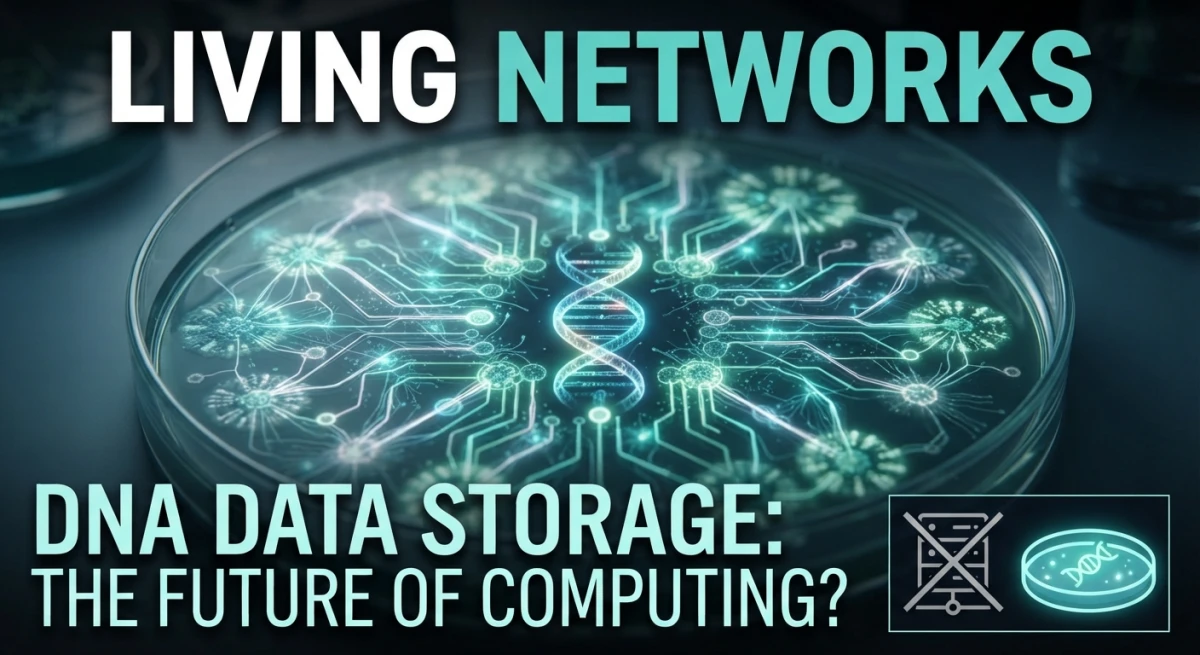
When most people picture the backbone of the internet, they imagine undersea fiber-optic cables, glowing server racks, and 5G cell towers. Yet inside university laboratories and synthetic biology startups, engineers are looking at a much older network architecture: bacterial colonies.
For billions of years, bacteria have coordinated group behavior without silicon chips or copper wires. By exchanging chemical molecules, passing genetic fragments, and generating electrical ion waves across biofilms, microbial communities process environmental information and adapt to stress.
Today, researchers in biocomputing and molecular communication are studying how to harness these natural mechanisms for ultra-dense data storage and self-healing sensor systems.
Still, there is a wide gap between genuine scientific progress and futuristic hype. Understanding what bacterial networks can actually do—and where they fall short of electronic infrastructure—helps clarify why this field matters.
How Bacterial Colonies Communicate and Compute
Bacteria rarely act as isolated single cells. When they gather in dense communities called biofilms, they rely on several natural signaling pathways that researchers treat like biological circuits:
-
Quorum sensing: Bacteria release and detect small signaling molecules called autoinducers. Once a colony reaches a specific population threshold, those signals trigger coordinated genetic changes—allowing millions of cells to switch behaviors simultaneously, much like a distributed logic gate.
-
Electrical ion signaling: Studies on Bacillus subtilis biofilms have revealed that bacteria can send potassium-ion waves across a colony to coordinate nutrient sharing between outer and inner cells. That electrochemical wave behaves similarly to a rudimentary nervous system.
-
Horizontal gene transfer: Microorganisms routinely swap small rings of DNA known as plasmids. Synthetic biologists use this natural exchange mechanism to program cells so they pass engineered instructions to neighboring bacteria.
By modifying these pathways, scientists have built living biosensors capable of detecting heavy metals, toxins, or disease markers and recording those events directly inside bacterial DNA.
The Promise of Self-Healing Biological Infrastructure
One of the biggest vulnerabilities of conventional telecommunications is physical fragility. If a backhoe severs a fiber line or a storm knocks out power to a switching station, traffic stops until human crews repair the hardware.
Living bacterial networks operate differently. Because microorganisms reproduce through cell division, a damaged biofilm supplied with water and nutrients can regrow across a surface and reestablish chemical or electrical signaling on its own. Researchers are exploring this property for engineered living materials—such as self-repairing coatings, smart wound dressings, and remote environmental monitors deployed in places where routine maintenance is impossible.
However, biological resilience comes with strict environmental limits. While bacterial spores can survive extreme radiation or electromagnetic pulses that would fry unshielded electronics, active bacterial colonies are sensitive to heat, drying out, contamination, and bacteriophages (viruses that infect bacteria). Unlike a router bolted into a rack, a living network requires carefully managed hydration, nutrients, and containment to keep functioning.
DNA Data Storage: Packing Exabytes Into Microscopic Space
Alongside living networks, DNA data storage is the most commercially active branch of biological computing. Rather than relying on magnetic platters or flash memory transistors, DNA storage converts digital binary code (0s and 1s) into sequences of the four nucleotide bases that make up genetic code: adenine (A), cytosine (C), guanine (G), and thymine (T).
The physical numbers behind DNA storage are striking:
-
Extraordinary density: Researchers estimate that one gram of DNA can theoretically store up to 455 exabytes of data—roughly hundreds of millions of gigabytes in a speck smaller than a drop of water.
-
Multi-century durability: Kept cold, dry, and shielded from light, synthetic DNA remains readable for thousands of years without consuming standby electricity. Hard drives and magnetic tapes, by contrast, typically require migration every five to ten years.
-
Low idle energy: Once written, DNA molecules sit inertly until needed, eliminating the massive continuous cooling and power demands of traditional cold-storage server halls.
Companies such as Twist Bioscience, Catalog, DNA Script, and Iridia are actively developing enzymatic synthesis and automated DNA storage cassettes aimed at national archives, scientific repositories, and long-term enterprise backups. Storing DNA inside living bacteria adds the ability for cells to copy that information naturally as they divide—though engineers must use strict error-correcting codes to prevent natural mutations from altering stored files over many generations.
Bacterial Networks vs. Electronic Infrastructure
Will a "global microbial web" ever replace 5G or undersea fiber-optic cables? Almost certainly not. The two technologies excel at completely different tasks.
| Feature | Electronic & Fiber-Optic Networks | Bacterial & DNA Bio-Systems |
| Transmission Speed | Near light speed; gigabits to terabits per second | Slow molecular diffusion or growth (seconds to hours) |
| Data Retrieval | Instant random access in milliseconds | Slow; requires chemical sequencing and decoding |
| Storage Density | High, but requires large physical server facilities | Up to hundreds of exabytes per gram (theoretical) |
| Self-Repair | Requires human technicians and spare parts | Regrows naturally when supplied with nutrients |
| Best Use Case | Real-time internet, streaming, cloud computing | Cold archival storage, biosensing, self-healing materials |
Electronic networks move massive streams of data across continents in milliseconds. Chemical diffusion and DNA sequencing take minutes or hours. Rather than competing head-to-head with silicon, biological systems are emerging as a specialized complementary layer—handling century-scale data archiving and autonomous environmental sensing where speed matters far less than density and longevity.
Frequently Asked Questions
What's Your Reaction?
 Like
0
 Dislike
0
 Love
0
 Funny
0
 Wow
0
 Sad
0
 Angry
0















Comments (0)